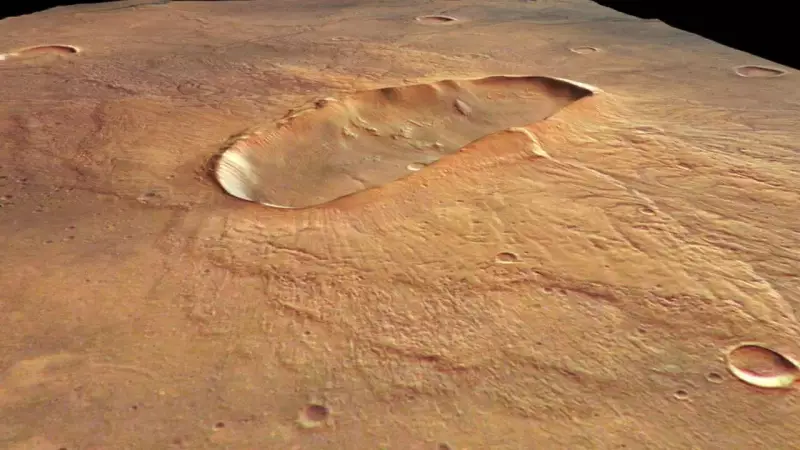
The European Space Agency (ESA) has unveiled a stunning and unusual geological feature on Mars that looks remarkably like a giant butterfly. Captured by the long-running Mars Express mission, this formation provides fresh clues about the Red Planet's violent past and its tantalising history with water.
A Cosmic Collision Creates Martian Art
On 3 December 2025, ESA published detailed images of this extraordinary find located in the Idaeus Fossae region. The butterfly shape is, in fact, a crater spanning roughly 20 kilometres in width and 15 kilometres in length. Unlike the typical circular pits that dot Mars, this crater boasts two distinct, wing-like lobes of ejected material.
Scientists explain that this unique geometry is the direct result of a shallow-angle impact. When a sizable space rock strikes a planetary surface at a low, grazing angle, the debris is not thrown out uniformly. Instead, it is propelled forcefully in two primary directions, sculpting the dramatic "wings" we see today. This rare formation acts as a natural laboratory, showing how impact angles and local terrain combine to create complex geology.

Fluidised Debris: A Sign of Subsurface Ice?
One of the most exciting details from the discovery is the nature of the ejected material. Some debris appears smooth and rounded, resembling the flow patterns of a mudslide. ESA researchers propose that the violent impact likely hit a layer of subsurface ice or water. The energy from the collision would have melted this ice, causing the rock and soil to mix with water and flow more easily—a process known as fluidisation.
This observation is significant. It suggests that water or ice was present near the Martian surface at the time of the impact. Understanding when and where water existed is a cornerstone in the quest to determine if Mars ever had conditions suitable for life. This butterfly crater adds a compelling piece to that puzzle.
A Landscape Shaped by Fire and Ice
The story of the Idaeus Fossae region is not written by impacts alone. The area surrounding the butterfly crater reveals a dynamic volcanic history. Steep, flat-topped mesas stand as remnants of ancient volcanic activity, with layers of dark material pointing to successive lava flows and ash deposits.
Furthermore, the landscape is marked by wrinkle ridges, features that form when cooling lava contracts. Together, these elements paint a picture of a world shaped by both internal fire and external bombardment. The butterfly crater sits at the intersection of these forces, offering a consolidated record of Mars's geological evolution.
Discoveries like this by the Mars Express orbiter are crucial. They allow scientists to refine models of impact processes, map the history of volcanic activity, and trace the potential role of water over billions of years. Each new feature brings us closer to understanding the full story of our planetary neighbour and its capacity to have once harboured life.