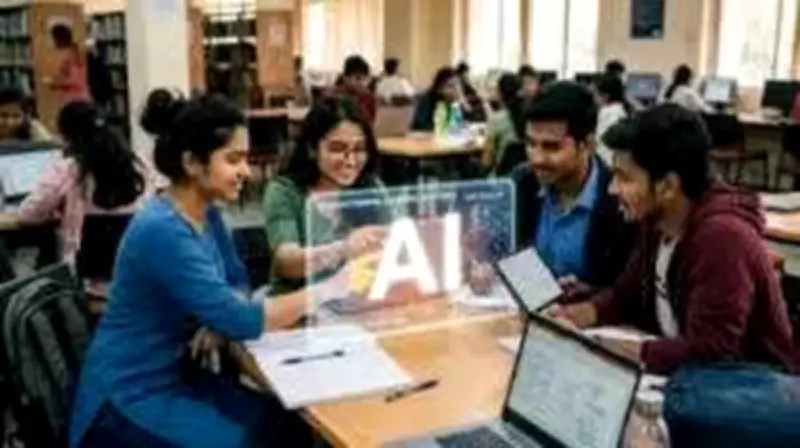
Chennai College Implements Mandatory AI Disclosure Policy for Student Assignments
In a significant move to promote responsible technology use in education, Stella Maris College in Chennai has introduced a mandatory declaration requirement for students regarding artificial intelligence usage in their academic work. The policy, which takes effect from the 2025-26 academic year, represents a proactive approach to addressing the growing influence of AI tools in educational settings.
Handwritten Honor Code and AI Framework Implementation
Students are now required to submit a handwritten honor code pledge with their assignments, explicitly stating they have not received any unauthorized or undeclared assistance, including from AI systems. This formal declaration aims to create greater accountability and transparency in academic work.
Complementing this requirement, the college has developed a comprehensive AI framework for learning and assessment that clearly defines acceptable and prohibited uses of artificial intelligence tools. The framework permits AI for specific supportive functions while establishing clear boundaries to maintain academic standards.

Four-Tier AI Usage Classification System
The college's policy establishes four distinct categories of AI usage for academic assignments:
- Open Usage: Permitted AI applications that require no special disclosure
- Usage with Disclosure: AI tools that must be explicitly acknowledged in submissions
- Usage with Compliance: AI applications subject to specific guidelines and restrictions
- Prohibited Usage: Banned AI applications that violate academic integrity standards
Notably, the framework prohibits AI-generated content entirely due to concerns about potential errors, biases, and lack of originality. However, it allows students to use AI for language polishing, grammar correction, and other supportive functions when properly disclosed.
Faculty Perspectives on AI Integration
Faculty member Faustina Joan from the computer science department explained the rationale behind the new policy: "We have observed numerous instances where students simply copy and paste content from AI tools without proper supervision or verification. Many fail to fact-check or validate the information generated by these systems."
She emphasized the college's balanced approach: "Our goal is to integrate AI into the learning process responsibly by allowing its use with proper disclosure. We view AI as an assistive tool rather than a replacement for genuine learning. This approach helps eliminate any guilt students might feel about using these technologies appropriately."
Student Responses and Behavioral Changes
Third-year BA economics student Dharanya shared her perspective: "The policy makes us feel a greater sense of ownership over our work. The college encourages AI use, but within ethical boundaries that preserve academic integrity."
Final-year BCA student Khashifaa noted observable behavioral changes among students: "Since the introduction of the honor pledge, students have become much more conscious about their AI usage. Faculty members specifically prohibit AI-generated code in programming assignments, which has reduced such usage by approximately half."
Strategic Vision for AI in Education
Rebecca Devaprasad, coordinator of the college's Internal Quality Assessment Cell, outlined the broader educational strategy: "Our 'AI Strategic Framework' aims to responsibly integrate AI tools into learning and assessment processes while maintaining academic integrity and fairness. We recognize that students will likely work with AI systems in their future careers, so we want to prepare them to use these technologies transparently and responsibly."
This forward-thinking approach acknowledges the inevitable role of AI in professional environments while ensuring students develop the ethical foundations necessary for responsible technology use.

Broader Institutional Trends in AI Policy Development
Stella Maris College is not alone in addressing AI policy concerns. Other prominent educational institutions in Chennai, including IIT Madras and Anna University, are reportedly developing their own comprehensive AI policies. This indicates a growing recognition among educational institutions of the need to establish clear guidelines for AI integration in academic settings.
The collective movement toward formal AI policies reflects higher education's response to rapidly evolving technological landscapes, balancing innovation with the preservation of traditional academic values and learning outcomes.