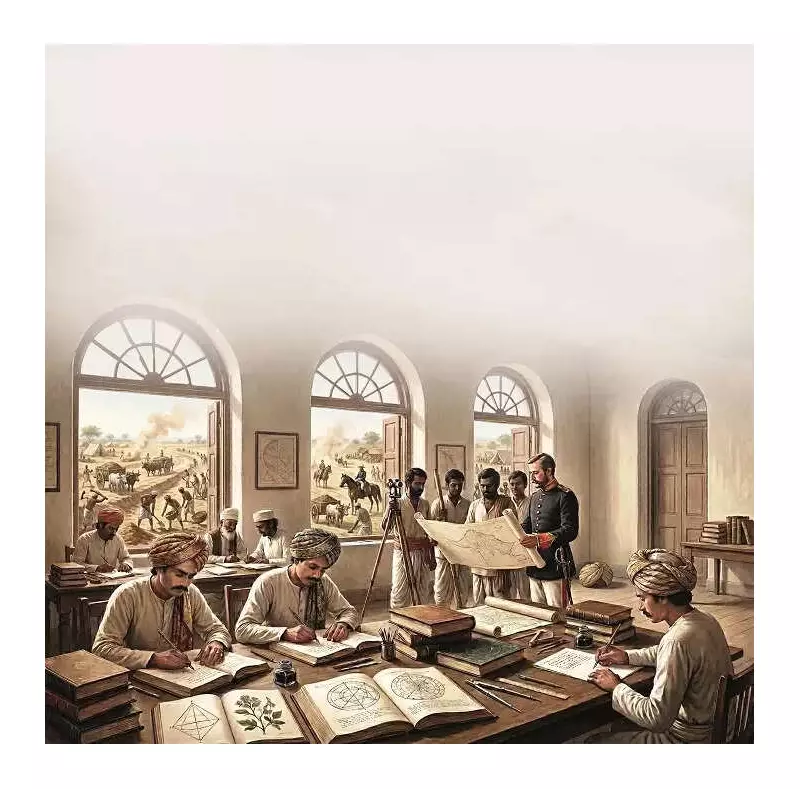
The year was 1823 in colonial Gujarat. A pressing infrastructure challenge – building roads, digging canals, and engineering bridges – faced Colonel George Ritso Jervis. He commanded thousands of skilled Indian workers, but a fundamental barrier stood in the way: all the essential mathematics textbooks were in English, a language his workforce could not read. The solution Jervis devised was extraordinary for a British officer of his era and would ignite an unexpected intellectual movement.
The Pragmatic Seed: Colonel Jervis's Textbook Revolution
Colonel George Ritso Jervis was not driven by a mission to enlighten the masses. His need was purely practical: his workers required a grasp of geometry to execute engineering projects. To solve this, he founded the Engineer Institution (Guneet Shilp Vidyalalya) in 1823. What followed was a remarkable personal endeavor. Jervis worked late into the nights, personally translating complex mathematical concepts to publish textbooks for his students.
Within a few years, he produced an impressive library. His works included "Gunit" (1825) on arithmetic, "Kartavya Bhumiti" (1826) on practical geometry for construction, and "Bijaganita" (1828), which made algebra accessible in Gujarati. He also translated works by Charles Hutton and Bonnycastle. This pragmatic response to a workforce problem laid the foundational stone for scientific education in the Gujarati language.

Literary Giants with a Scientific Day Job
Jervis's initiative set a precedent that entangled some of Gujarat's most celebrated literary figures in the systematic translation of scientific knowledge. Their government positions demanded it, creating a unique duality in their careers.
Mahipatram Rupram Nilkanth (1829-1891) is celebrated as the author of Gujarat's first novel and its first travelogue to England. However, history often overlooks his official designation: "Gujarati translator, education department." From 1867 onwards, his salaried government work involved translating scientific textbooks. He rendered Theodore Cooke's "Manual of Geology" into "Bhustaravidyana Mulatattvo" (1873) and produced works on physics like "Padartha Vignan" (1883). The man who wrote passionately about his travels spent decades translating geology and physics because his government salary depended on it.
Nandashankar Tuljashankar Mehta (1835–1905), famed for writing "Karan Ghelo," the first Gujarati novel, also worked as a trigonometry translator. His entire career was embedded in the colonial education system, working under figures like James Graham and alongside Mahipatram on textbook committees.
The story of Chhotalal Sevakram (1842–1910), who later became a minister in Kutch, reveals the bureaucratic nature of this work. As a "translation exhibitioner," he produced "A Manual of Geography" (1868). Intriguingly, he did not translate directly from English but from a Marathi version prepared by another official, showcasing the rigid hierarchies within the translation machinery.
Passion, Poverty, and a Legacy of Knowledge
While many translated as a bureaucratic duty, some were driven by deeper passion. Jaykrishna Indraji Thakar (1849-1925) stands out. Born into poverty in Kutch, he discovered a gifted ability to match local plant names with Latin botanical terms. This skill led him to a position with the Rana of Porbandar. At 61, he published his 719-page magnum opus, "Vanaspatishashtra," documenting the flora of Barda Mountain. To fund the first print run, he mortgaged his wife's jewellery. When advised that an English edition would sell better, he famously stated that profit was irrelevant; his goal was to empower Indians to identify flora themselves. Years later, Mahatma Gandhi would use this very book for his naturopathy experiments in South Africa.

The translation movement expanded beyond mathematics. Harilal Mohanlal created "Bhugola ane Khagola" in 1833, Gujarat's first geography text. Mehrvanji Hormazji Meheta produced the earliest chemistry translation, "Rasayanasastra Sambandhi Batchit," in 1851. Others like Balvantram Mahadevram Mehta sustained the work in mathematics and astronomy into the 1880s.
Reconstructing a Hidden Historical Narrative
This fascinating confluence of colonial administration, linguistic labor, and knowledge dissemination represents what scholar Sunil Sagar, a professor of English Studies at the Central University of Gujarat, calls a "blank space in history." His research seeks to map how scientific knowledge was received in Gujarat, identifying the people and institutions that circulated these books.
"I seek to map out how scientific knowledge was received in Gujarat, identifying the actors and institutions involved in circulating these books," says Sagar. His work aims to answer what drove these scholars—from pragmatic colonels to salaried novelists—to undertake this translation work, revealing a complex chapter where the needs of empire inadvertently fostered a vernacular scientific lexicon that would outlast its creators.
The legacy of Colonel Jervis's 1823 decision is a testament to how the practical need to build bridges and roads ultimately helped build a bridge of scientific terminology and thought into the Gujarati language, carried on the shoulders of its most unlikely translators.