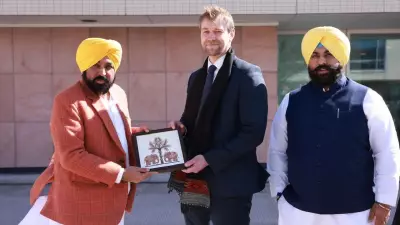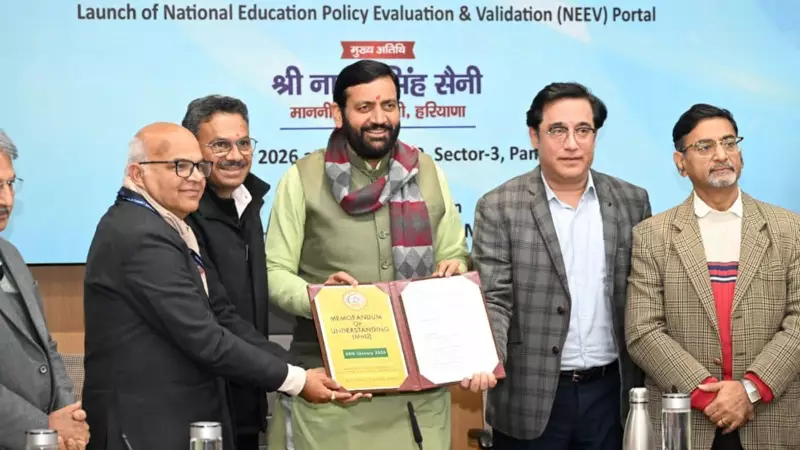
Haryana Chief Minister Nayab Singh Saini has announced a comprehensive set of educational and governance reforms aimed at positioning the state as a national leader in innovation and skill-based development. The announcements were made during a programme held in Panchkula on Thursday.
Digital Push and Educational Overhaul
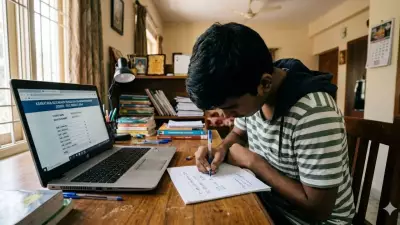
Saini launched the National Education Evaluation and Validation (NEEV) portal, a digital platform designed to track the implementation of the National Education Policy (NEP) across schools, colleges, and universities. According to a government spokesperson, this portal will allow institutions to submit data in phases, facilitating evidence-based planning and policy decisions.
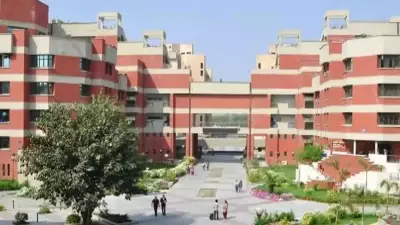
Simultaneously, Memoranda of Understanding were signed under the 'Gyan Setu' initiative between the Golden Jubilee Haryana Institute for Fiscal Management and several universities. These agreements are intended to foster collaboration, integrate research, and build institutional capacity focused on skills.

Budgetary Boost for Research and Future-Ready Curriculum
A landmark decision highlighted by the Chief Minister was the allocation of Rs 20 crore for research in the state budget, marking the first such dedicated fund. Saini stated that this fund would support problem-driven research in critical areas like urban infrastructure, environmental sustainability, and water management, enabling academia to contribute directly to practical policy solutions.
Emphasising the shift from conventional degrees, Saini outlined that educational reforms are aligned with the Vision Document–2047. Universities are being encouraged to create industry-linked training programmes and use digital platforms to align academic curricula with workforce demands, ensuring graduates are job-ready for emerging sectors like artificial intelligence and semiconductors.
Next Phase of Governance and Economic Reforms
Beyond education, Saini detailed the next phase of welfare and economic reforms. A key initiative is an AI-enabled pre-budget feedback portal that will invite citizens to participate actively in the budget planning process. For the agricultural sector, programmes will promote crop diversification, modern horticulture, natural farming, and export-oriented infrastructure to boost farmers' incomes.
The Chief Minister concluded by asserting that these combined steps—focusing on institutional reforms, citizen participation, and research-led policymaking—are designed to make governance more responsive and technology-driven. "The next decade is about turning vision into action," Saini said, aiming to empower every citizen in shaping Haryana's future and setting a national benchmark.