Haryana Students Build Real Businesses While Still in School
Students in Haryana's government schools are doing something remarkable. They are not just studying textbooks and preparing for exams. These young minds are building actual businesses, facing real-world challenges, and learning what it means to be entrepreneurs while still in school.
From Classroom Theory to Market Reality
Haryana Education Minister Mahipal Dhanda recently highlighted this transformation. "We want students to move from being job seekers to job creators," Dhanda said during the state-level Yuva Startup Mahotsav. This event showcased businesses developed by government school students under Haryana's innovative Kushal Business Challenge program.
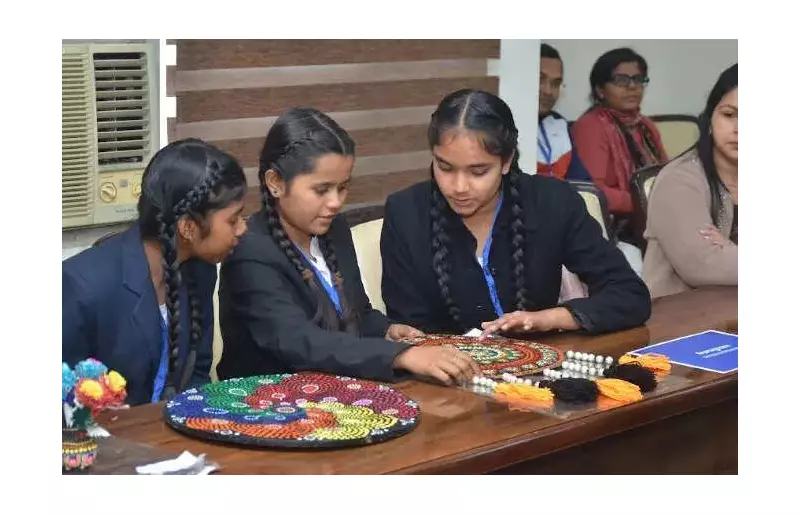
The festival felt like a college startup expo. At one stall, students explained how kitchen waste could rejuvenate tired soil. At another, teenagers described selling products on Amazon and Flipkart without owning any inventory. Colorful hand-dyed fabrics shared space with organic fertilizer made from poultry waste.

A Structured Journey Toward Entrepreneurship
All these ventures came together on January 5 at Panchkula's Indradhanush Auditorium. The Yuva Startup Mahotsav marked the culmination of KBC 2.0 with live stalls and certificate distribution ceremonies.
The Kushal Business Challenge represents a fundamental shift in how business education gets delivered. Implemented by the department of school education along with HSSPP, SCERT and Udhyam Learning Foundation, KBC moves business education far beyond theoretical classroom discussions.
"KBC represents a shift toward experiential learning," explained Vineet Garg, IAS, additional chief secretary for school education. "Students apply classroom concepts to real-world challenges and develop critical thinking and problem-solving skills."
Impressive Numbers and Growing Reach
The initiative began as a pilot experiment last year before formally rolling out in October 2024 for Class 11 and 12 students, particularly those in vocational streams. The goal was simple but ambitious: introduce entrepreneurship before students left school.
In KBC 2.0 alone, more than 25,000 students from 1,062 schools formed 5,640 teams and developed over 5,000 business ideas. These ideas went through multiple competitive rounds at school, block and district levels before 66 teams reached the state summit. Each of these final teams received Rs 1 lakh in seed funding.
Overall, the program now reaches 1.18 lakh students across more than 2,500 government schools. With Education Minister Dhanda announcing the expansion of KBC to Classes 9 through 12 from the next academic session, the initiative continues to grow.
Real Problems, Real Solutions
Instead of preparing file-based projects, students identify actual problems in their surroundings. They design solutions, test them in local markets, interact with customers, handle pricing and costs, face rejection, and refine their ideas based on feedback.
"We use business ideas as a tool to teach entrepreneurship," said Myank Verma, joint state project director in the department of school education. "Students are not just reading about economics anymore. They are learning production, logistics, supply chains, raw material sourcing and market analysis by actually doing it."
The curriculum exposes students to the complete startup ecosystem, including taxation, revenue projections, angel investors and incubators. By the program's end, students can judge whether an idea is economically viable.
Student Ventures Making Real Impact
One standout project came from Gurgaon's GMSSSS Badshahpur. Students behind Resoil Organics noticed a contradiction they saw every day. Fields increasingly depended on chemical fertilizers while soil health declined, yet organic waste from homes and communities got dumped as useless. Their venture converts organic waste into natural fertilizers and promotes vermicomposting through simple awareness kits.

In Rewari, Nitil Saini of GSSS created Nature Goals by connecting two local problems. He noticed people wanted thriving home gardens but found good fertilizer expensive, while nearby poultry farms struggled to manage waste. His solution converts poultry waste into clean, affordable organic fertilizer for balcony gardeners, nurseries and schools. The venture has earned Rs 54,000 so far.
For Abhishek, a student of GMSSSS Indachhoi in Fatehabad, the problem involved market access. He saw local sellers and students disconnected from online markets even as global e-commerce platforms grew rapidly. Through KBC, he learned about supply chains, logistics and digital marketplaces. This led to Balaji Mart, a dropshipping venture that sources products in bulk and sells them through platforms like Amazon, Flipkart and Meesho. The business generated Rs 90,000 in revenue and earned a one-year incubation at IIT Ropar.
In Ambala, students from GMSSSS Mohri Bhanokheri focused on farming challenges. Watching farmers spend more every season while soil quality worsened, they revisited traditional agricultural practices. Their Eco Farm Crate brings together natural inputs like Jeevamrit, Beejamrit, compost and plant-protection solutions in one kit, making natural farming easier for various users.
Cultural roots also found expression through entrepreneurship. In Hisar, students of GGSSS Aryanagar launched Rang Riwaz, inspired by the tie-and-dye tradition they grew up with. Working from home using eco-friendly dyes, they produce customized suits, sarees, dupattas and home furnishings. The venture has generated Rs 40,000 in revenue and received seed funding.
Rigorous Assessment and Support Systems
To maintain quality, the department introduced a rigorous four-level assessment process. This starts at the school level with principal-led juries and moves through block and district rounds where industry experts and MSME officials question students on scalability and business fundamentals.
"We ask them tough questions," Verma explained. "How they would scale production a thousand times, what investment they would need, how many people they would employ."
The program integrates into the vocational education framework taught from Classes 9 to 12. Extensive training gets provided to teachers and principals to ensure they understand the intent behind it.
Financial support matches with mentorship. Winning teams receive Rs 1 lakh in stages along with guidance from the skill development department and NGOs like Udhyam to turn early ideas into workable business plans.
The approach proved impactful enough for the program to be mentioned in the chief minister's budget speech this year. This marks its transition from a pilot experiment to a flagship state initiative that could reshape how students approach their futures.