The Hidden Number Challenge: A Simple Grid That Tests Your Brain's Pattern Recognition
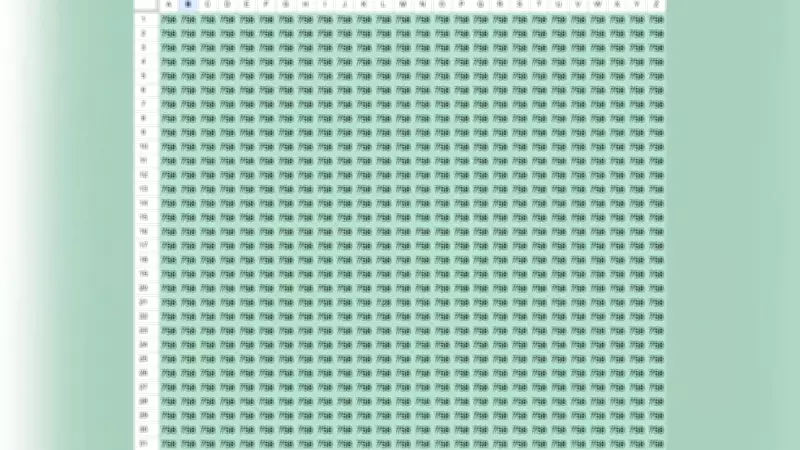
At first glance, it appears to be a straightforward image of organized grids. Each box displays the identical number: 758. However, concealed somewhere within this neat, Excel-style sheet is a different digit: 728. The clever twist? It blends in so seamlessly that most observers' eyes glide right past it without detection.
Why This Puzzle Is More Difficult Than It Initially Seems
The human brain naturally adores patterns and consistency. When it repeatedly encounters the same number—758, 758, 758—it begins to anticipate and predict what comes next. This cognitive shortcut proves immensely helpful in daily routines and tasks, but in puzzles like this one, it transforms into a subtle trap.
Children, in particular, tend to scan quickly and assume uniformity across the grid. That is precisely why the hidden number 728 often feels nearly "invisible." The distinction between 758 and 728 is merely a single digit alteration, yet spotting it demands slowing down and paying meticulous attention to detail.

This is where genuine learning and cognitive development occur. The puzzle serves as a gentle exercise in mental discipline.
What Children Actually Learn From This Engaging Activity
This seemingly simple challenge cultivates far more than basic observation abilities. It trains young brains in quiet yet profoundly powerful ways:
- Attention Control: Kids learn to decelerate their mental pace instead of rushing through tasks.
- Visual Scanning: Their eyes practice moving more carefully and systematically across rows and columns.
- Pattern Awareness: They begin to question and scrutinize what initially appears "obvious" or predictable.
- Patience and Persistence: Not immediately locating the hidden number teaches valuable lessons in endurance and continued effort.
These are the very same foundational skills applied in reading comprehension, mathematical problem-solving, and even athletic coordination. A child who learns to notice subtle differences early on frequently develops greater confidence in tackling complex challenges later in life.
A Gentle Approach for Parents to Guide and Support
Instead of hastily revealing the answer, parents can guide their children with subtle, encouraging hints. Suggest checking one row at a time or moving a finger methodically across the grid. This transforms the activity into a shared, collaborative moment rather than a mere test of ability.
A simple, open-ended question often works wonders: "What if the number is hiding precisely where you least expect it to be?" This gently nudges the child to reconsider their approach without applying undue pressure.
Celebrate the effort and process, not solely the final result. Whether they discover the hidden number in ten seconds or two minutes, the cognitive journey holds more significance than the speed of completion.
The Revealed Answer and Its Deeper Educational Value
The concealed number 728 is strategically located in the K column and the 21st row of the grid.
Once unveiled, many children react with genuine surprise and exclaim, "It was right there all along!" And that is precisely the core lesson. The brain learns that careful, deliberate observation can uncover what initially seemed impossible or overlooked.
This small, triumphant moment builds authentic confidence. It communicates to children that challenges, both big and small, can be resolved with patience, persistence, and a fresh perspective.
Why Such Puzzles Hold Significant Relevance Today
In an era dominated by rapid scrolling, instant gratification, and quick digital answers, children seldom receive opportunities to pause and observe deeply. Activities like this hidden number puzzle intentionally create that essential mental pause.
They are elegantly simple, screen-friendly, and yet profoundly engaging for the mind. No loud instructions, no competitive pressure—just quiet, focused thinking. Over time, these mindful moments shape how a child approaches larger academic and life challenges with resilience and curiosity.