Ancient India's Pythagorean Theorem: A Peacock, Snake, and Geometry Story
What if we revealed that one of the most famous theorems taught in schools worldwide—the Pythagorean theorem—was known in India centuries before the Greek mathematician Pythagoras was even born? And what if this profound knowledge was not presented through dry formulas but woven into a captivating poetic tale about a peacock and a snake? Welcome to the fascinating world of Indian mathematics, where geometry seamlessly blended with storytelling, and intuitive insights often predated formal proofs by hundreds of years.
A Problem from the 12th Century That Still Feels Modern
In the 12th century, the renowned mathematician Bhaskara II (1114–1185 CE) authored a significant mathematical treatise titled Siddhanta Siromani. One of its most celebrated sections, Lilavati, presents mathematics not as mere mechanical calculations but as lively, engaging puzzles that breathe life into numbers. Here is one such intriguing problem: A snake's hole lies at the base of a pillar that stands nine cubits high. A peacock perches atop this pillar. The snake is spotted at a distance three times the pillar's height, moving toward its hole. The peacock swoops down obliquely to intercept it. At what distance from the hole do they meet, assuming both travel equal distances?
Pause for a moment and visualize the scene: the tension, the chase, the drama. Now, imagine solving this geometric puzzle back in the 1100s, without modern tools or notation. This challenge not only tests mathematical skill but also showcases the creative approach of ancient Indian scholars.

Solving the Peacock's Puzzle
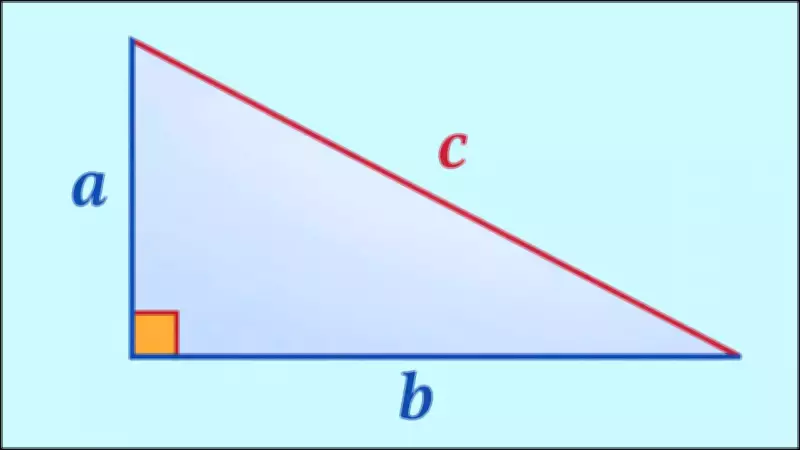
To unravel the peacock's puzzle, we begin by translating Bhaskara II's vivid narrative into geometric terms. The pillar serves as the vertical side of a right triangle, measuring 9 cubits. The snake starts 27 cubits away from its hole, forming the horizontal distance. When the peacock dives in a straight line, its flight path becomes the hypotenuse. This setup immediately invokes the Pythagorean relationship: a² + b² = c². However, the fascinating aspect is that this geometric principle was already well-established in India long before Bhaskara II's time.
Long Before Greece: The Sulba Sutras
Centuries before classical Greek mathematics flourished, Indian scholars composing ritual manuals known as the Baudhayana Sulba Sutras (circa 800 BCE) described geometric constructions used for building Vedic fire altars. One notable statement reads: "The diagonal of a rectangle produces both areas separately." In modern terminology, this translates to a² + b² = c²—the Pythagorean theorem expressed verbally nearly 300 years before Pythagoras (circa 570–495 BCE). Importantly, the Sulba Sutras go beyond mere statements; they provide numerical examples, Pythagorean triples, and detailed geometric constructions.
Historians of mathematics, such as Kim Plofker in "Mathematics in India" (2009) and George Gheverghese Joseph in "The Crest of the Peacock" (2011), have extensively documented this early Indian knowledge, highlighting its sophistication and practical applications.
Was It Really "1000 Years Earlier"?
You might have encountered claims that India knew the Pythagorean theorem a thousand years before Pythagoras. While this is an exciting assertion, a closer look at the timeline reveals a more nuanced picture. The idea appears in the Baudhayana Sulba Sutras around 800 BCE, with Pythagoras living around 570 BCE, resulting in a gap of approximately 300 years, not a full millennium. Nevertheless, this clearly demonstrates that the principle was understood in India centuries before it became associated with Greek mathematics.
It is crucial to distinguish between knowing a rule and providing a formal proof. Ancient Indian scholars grasped the geometric relationship and applied it in practical constructions, such as altar building. Earlier still, Babylonian tablets from around 1800 BCE exhibit number patterns adhering to the same rule. Later, around 300 BCE, Euclid presented a rigorous, step-by-step logical proof in his seminal work "Elements," a tradition that greatly influenced European mathematics and led to the theorem bearing Pythagoras's name.

Today, historians widely agree that this mathematical idea did not originate in a single civilization. It emerged independently across cultures: in Babylonian calculations, Indian geometry, Greek proofs, and even Chinese mathematics. Rather than viewing it as a solitary invention, the theorem is better understood as part of a shared global journey of mathematical discovery, reflecting humanity's collective intellectual progress.
Why This Matters for Students
You might wonder why this historical context holds significance. It matters because mathematics is not the exclusive achievement of one civilization but an integral part of humanity's shared narrative. Recognizing that Indian mathematicians engaged with geometric concepts centuries before classical Greece, that problems were taught through engaging stories rather than abstract formulas, and that real-world needs like altar construction and astronomy drove innovation makes mathematics feel more human, relatable, and exciting.
Indian mathematics was often remarkably advanced for its time. For instance, the place-value system and the concept of zero were formalized in India. In Kerala, mathematicians developed ideas about infinite series centuries before similar concepts appeared in European calculus. Astronomers crafted detailed computational models to track planetary movements with impressive accuracy. In this light, the peacock-and-snake problem is not merely a clever geometry puzzle; it exemplifies a culture that harmoniously blended poetry, logic, and practical thinking.
A Different Way to Think About Proof
Bhaskara II was renowned for his elegant explanatory style. In one famous demonstration of the Pythagorean relationship, he presented a diagram with a single word meaning "Behold!" The intention was that the visual arrangement itself made the truth self-evident. Instead of relying on lengthy logical chains, he often employed geometric rearrangements that allowed students to grasp results instantly. This approach differed from the Greek method, where mathematicians like Euclid meticulously constructed arguments step by step in works such as "Elements." Neither method is superior; they simply represent diverse ways of conceptualizing mathematics, each with its own merits.
Mathematics as Storytelling
Modern textbooks typically introduce formulas first, followed by examples. In contrast, Lilavati often reversed this order: students first encountered vibrant scenarios—merchants calculating pearls, bees hovering over flowers, or a peacock diving toward a snake—with the mathematics embedded within the narrative. This method made learning natural and engaging, as numbers were not abstract entities but integral parts of imaginable scenes. Perhaps contemporary classrooms can rediscover this approach, demonstrating that imagination and logic can collaborate beautifully to enhance understanding and retention.
The Global Lesson
So, was the Pythagorean theorem truly "invented" by Pythagoras? History suggests a more complex and enriching answer. Numerical patterns were known in Babylon, the geometric rule appeared in Indian texts like the Baudhayana Sulba Sutras, and the formal proof tradition was developed and preserved in Greece. Over time, the Greek name became attached to the theorem, but the knowledge itself was a cross-cultural phenomenon. Acknowledging this does not diminish Greek contributions; instead, it helps us appreciate how ideas traverse borders, evolve, and connect civilizations, fostering a richer appreciation of our shared intellectual heritage.
Sources and Further Reading
For readers eager to delve deeper, key sources include Bhaskara II's Lilavati (12th century CE), the Baudhayana Sulba Sutras (circa 800 BCE), Kim Plofker's "Mathematics in India" (Princeton University Press, 2009), George Gheverghese Joseph's "The Crest of the Peacock" (Princeton University Press, 2011), and Euclid's "Elements" (circa 300 BCE). These works offer comprehensive insights into the historical development and cultural contexts of mathematical ideas.
A Final Thought for Students
The next time you write a² + b² = c², take a moment to reflect. Imagine a Vedic altar builder measuring diagonals, a Sanskrit poet-mathematician composing verses, a Greek geometer constructing proofs, and a Babylonian scholar inscribing numbers on clay tablets. All of them were contemplating the same fundamental triangle. Mathematics is older, broader, and more interconnected than any single name suggests. Perhaps this realization—that our mathematical heritage is a tapestry woven from diverse threads—is the most beautiful lesson this timeless theorem has to offer.