

Judiciary Gold Experts Reveal Key to Cracking Competitive Judicial Exams
For countless law graduates and final-year L.L.B students throughout India, passing the Judiciary exam represents more than a career milestone—it is a profound aspiration to serve as a Civil Judge within the justice system. However, with intensifying competition, shifting exam formats, and extensive syllabi, a critical question persistently challenges aspirants: Should the focus be on theoretical knowledge or practical application?
The Evolving Landscape of Judiciary Examinations
Judiciary exams in India generally comprise three distinct phases: the Prelims, featuring objective multiple-choice questions; the Mains, centered on descriptive answer writing; and the Interview, a personality assessment. While prelims evaluate conceptual understanding and quick recall, mains assess legal articulation, structured reasoning, and the application of statutes. States such as Rajasthan, Uttar Pradesh, Madhya Pradesh, and Bihar conduct highly competitive exams annually, significantly narrowing the margin for error. Previously, candidates could succeed in prelims with robust Bare Act knowledge alone, but today, performance hinges on effectively translating that knowledge into written responses.
The Core Dilemma: Theory Versus Practice
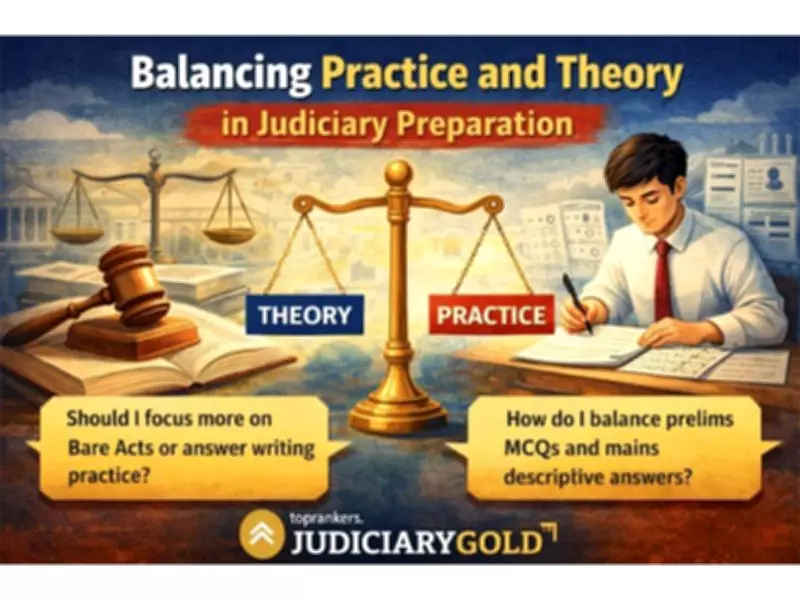
Many aspirants dedicate months to studying Bare Acts, standard textbooks, and notes, yet falter when composing answers for the mains. Conversely, some students prematurely engage in answer writing without establishing a solid conceptual foundation. Both strategies result in significant gaps. Specialists at Judiciary Gold by Toprankers stress that theory forms the essential groundwork, while practice transforms that knowledge into tangible marks.

Strategic Approach to Bare Acts and Answer Writing
A prevalent inquiry among judiciary aspirants is whether to prioritize Bare Acts or answer writing practice. The solution is straightforward yet frequently misinterpreted: neither can be neglected. The optimal method involves commencing with Bare Acts to grasp the precise legal language, which is vital for both prelims and mains. Subsequently, integrate regular answer writing practice to develop structured responses and effectively present legal provisions. The crucial skill lies in converting textual comprehension into articulate writing. Mentors at Judiciary Gold by Toprankers observe that students who amalgamate Bare Act study with consistent answer writing perform markedly better in the mains.
Balancing Prelims and Mains Preparation
Another significant challenge for aspirants is concurrently managing preparation for prelims and mains. Prelims demand speed, accuracy, and MCQ proficiency, whereas mains require detailed understanding, structured writing, and case law integration. Achieving equilibrium is difficult but imperative. Experts at Judiciary Gold by Toprankers advocate a dual-preparation strategy:

- Establish a Robust Conceptual Base: Focus on comprehending laws through Bare Acts and standard materials to support both exam stages.
- Dedicate Daily Time to MCQs: Solve a fixed number of multiple-choice questions daily to enhance speed and pinpoint weaknesses.
- Practice Answer Writing Regularly: Engage in writing answers three to four times weekly, progressing from simple to complex questions.
- Analyze Performance: Critically assess both MCQ and written answers to identify errors and refine techniques.
- Integrate Study Methods: Approach topics with consideration for how they might appear in both MCQ and descriptive formats, viewing prelims and mains as interconnected components of a unified preparation journey.
Common Pitfalls and the Role of Structured Guidance
Despite diligent effort, many aspirants fail to clear judiciary exams due to over-reliance on passive reading, insufficient answer writing practice, delayed MCQ preparation, and poor time management. This imbalance often leads to clearing one stage while failing the other. For those seeking judiciary coaching, structured guidance becomes essential. At Judiciary Gold by Toprankers, the preparation model ensures balance through comprehensive Bare Act coverage, regular MCQ sessions, dedicated answer writing programs, and personalized mentor feedback, fostering both conceptual clarity and practical application skills.
Transitioning from Law School to Judiciary Preparation
Students moving from law school to judiciary preparation frequently encounter adaptation difficulties. Law school emphasizes concept understanding, assignment writing, and academic discourse, whereas judiciary exams require speed, precision, exam-oriented writing, and concise answers. This shift necessitates a revised preparation strategy, underscoring the importance of consistency. Successful aspirants regularly revise Bare Acts, practice MCQs consistently, write answers frequently, and analyze their performance, ensuring simultaneous improvement in theory and practice.
Conclusion: The Imperative of Balance
Judiciary exams assess not only knowledge but also its application. Exclusive focus on theory or practice creates deficiencies that can compromise marks. True success derives from balance. For all judiciary aspirants—whether final-year students, drop-year candidates, or law school graduates—the directive is clear: build strong fundamentals, practice regularly, and integrate preparation comprehensively. As highlighted by experts at Judiciary Gold by Toprankers, it is the harmonious balance between theory and practice that ultimately defines achievement in judiciary examinations.





