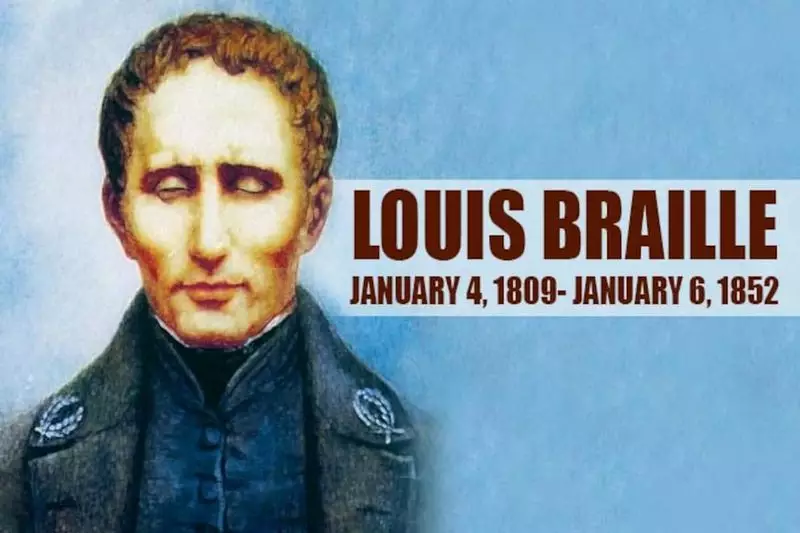
Every year on January 4th, the world pauses to honor a visionary whose simple yet profound invention dismantled barriers for millions. This date marks the birth anniversary of Louis Braille, the French educator who gifted the gift of literacy and independence to the visually impaired community by creating the Braille script. As we commemorate his 215th birth anniversary, celebrated globally as World Braille Day, his legacy continues to illuminate paths in the dark.
The Accident That Sparked a Vision
Louis Braille's journey was born from a tragic accident. In 1812, as a three-year-old boy in Coupvray, France, he was playing in his father's workshop. A sharp awl, a tool used for punching leather, accidentally slipped and struck his eye. The injury was severe and led to a devastating infection that spread to his other eye. By the age of five, young Louis was completely blind.
Despite this immense challenge, his spirit remained unbroken. His family and local priest recognized his sharp intellect and ensured he received an education. His academic prowess earned him a coveted scholarship at the age of ten to the Royal Institute for Blind Youth in Paris. It was here that his frustration with the existing, cumbersome systems of reading for the blind planted the seed for a revolution.

From Military Code to Literary Liberation
At the institute, students were taught using a method called "Haüy writing," which involved feeling raised impressions of Latin letters. The process was slow and inefficient, making it nearly impossible to write. The turning point came in 1821 when a retired French army officer, Charles Barbier, visited the school. He introduced "night writing," a 12-dot tactile code originally designed for soldiers to communicate silently on dark battlefields.
While the military found it too complex, the young Louis Braille saw its potential. He dedicated the next three years of his life, starting at just 12 years old, to refining and simplifying this system. By 1824, he had successfully created his own six-dot cell configuration. This elegant system, where different combinations of raised dots within a cell represent letters, numbers, and musical notations, was far more intuitive and learnable. Louis Braille published the first-ever Braille book in 1829, at the age of 20, and presented a refined version including musical notation in 1837.
A Legacy of Empowerment and Independence
Despite initial resistance from sighted educators at his own institute, the brilliance of Braille's system was undeniable to its users. It spread organically among the students because it worked. For the first time, blind individuals could read and write with speed, privacy, and ease. The script opened doors to education, employment, and personal expression that were previously firmly shut.
Today, Braille is more than just a tool; it is a symbol of autonomy and inclusion. Its applications are vast and critical:
- Education: It is the primary medium of literacy for blind children, enabling them to access textbooks, literature, and scientific concepts.
- Daily Life: Braille labels empower individuals to identify everyday items like medicine bottles, food packages, and elevator buttons independently.
- Public Accessibility: It is integrated into public signage, ATM keypads, and restaurant menus, fostering an inclusive environment.
- Professional and Artistic Pursuits: From composing music to pursuing careers in law, teaching, and technology, Braille provides the foundational literacy required for success.
Louis Braille's life was cut short by tuberculosis in 1852 at the age of 43. He did not live to see the global adoption of his system, which gained official recognition in France two years after his death and eventually became the worldwide standard. In a final, fitting tribute, his hands were preserved and placed in a sealed urn in his hometown, while his body was moved to the Panthéon in Paris among the nation's greatest heroes.

On this World Braille Day, his story is a powerful reminder that innovation born from personal struggle can transform humanity. His six dots continue to be a bridge to knowledge, culture, and connection, proving that true vision is not always about sight, but about insight and the courage to change the world.