Happy Hands School in Odisha: A Bilingual, Eco-Friendly Model for Hearing-Impaired Children
Children with hearing disabilities often face significant challenges in traditional classrooms. Many schools lack proper accommodations for these students. At home, the situation can be even more difficult. Numerous children grow up without any exposure to sign language. This absence leads to delays in both linguistic and cognitive development.
A Personal Mission Takes Root
Sibaji Panda understood these struggles from personal experience. He grew up in a remote village within Subarnapur district. Despite his own hearing impairment, Panda pursued higher education with determination. He earned a master's degree from the University of New England. He also completed a PhD in special education.
Panda carried a deeply personal mission throughout his academic journey. He wanted to build a school specifically for hearing-impaired learners. Crucially, he envisioned this institution being led by hearing-impaired educators themselves.

From the UK to Lakhanpur Village
A decade ago, Panda made a life-changing decision. He quit his job as a senior lecturer at the University of Central Lancashire in the United Kingdom. He returned to his home village of Lakhanpur in Odisha. His dream was clear: to establish a truly inclusive residential school for hearing-impaired children.
Panda wanted the school to be holistic and future-oriented. This dream materialized as 'Happy Hands'. Today, his institute receives international praise for its innovative approach.
UNESCO Recognition and a Unique Model
UNESCO recently recognized Happy Hands as a unique and pioneering model. The organization highlighted its inclusive, bilingual, and eco-centric education for hearing-impaired children in rural Odisha. The school featured in UNESCO's State of the Education Report for India 2025 - 'Bhasa Matters'. This report published earlier this month.
"What makes our school unique is its bilingual approach and eco-education," Panda stated. Unlike many special schools that focus on oral teaching, Happy Hands ensures Indian Sign Language (ISL) is used everywhere. Students use ISL inside classrooms and in daily life on the campus.
Panda established a sign-bilingual model at the school. In this system, ISL functions as the first language. This provides a strong cognitive foundation for students. They then learn English as a second language. English is taught primarily as a written language. This method enables children to grow up bilingual.
"We also started teaching Odia and Hindi as additional languages," Panda explained. His work has gained such prominence that President Droupadi Murmu invited him to attend the 'At Home' reception on Republic Day.
An Environment Built on Inclusion
All educators at Happy Hands are hearing-impaired teachers. This is a core principle of the institution. Residential staff members who are not hearing-impaired must learn and use sign language. This requirement ensures the environment remains genuinely inclusive for every student.
Panda emphasized the importance of sign language based on both research and lived experience. He said sign language plays a crucial role in developing independent thinking. It also helps build strong cognitive foundations.
"Most deaf children in India suffer cognitive setbacks due to language deprivation," Panda noted. "When children grow up in families and communities where no one knows sign language, which is the case for the vast majority, they miss out on natural language acquisition during the most critical early years. This deprivation can have serious, long-lasting effects."
The Structure and Philosophy of Happy Hands
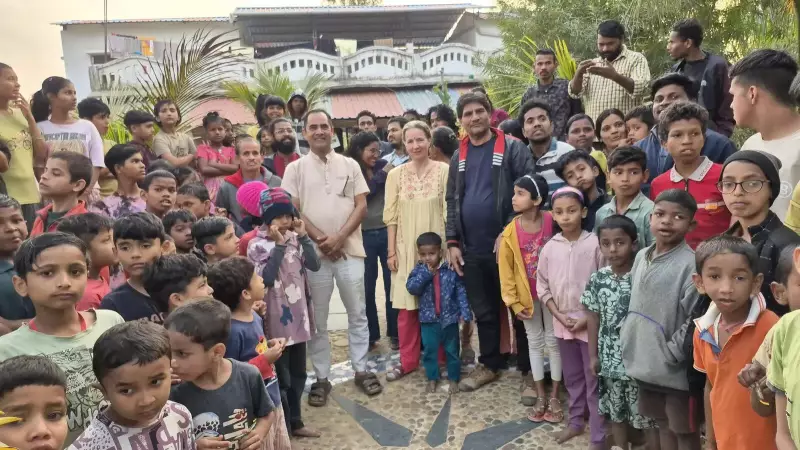
The school offers fully residential education from LKG to Class VIII. It maintains a small, focused intake. Happy Hands admits only 10 to 12 children every year. Admissions occur only in early grades like LKG and UKG. Currently, around 70 children are enrolled. The oldest students study in Class VIII.
All education, boarding, and care at the school are provided free of cost. The institution runs entirely on voluntary funding. Education at Happy Hands extends far beyond standard textbooks.

Students participate daily in eco-campus activities. These include gardening and small design projects. These projects integrate seamlessly into mathematics, science, and art lessons. "We are starting eco-vocational training for older students this year," said Panda. He is also a former vice-president of the Indian Sign Language Interpreter Association.
Happy Hands stands as a testament to one man's vision. It transforms the educational landscape for hearing-impaired children in rural Odisha. Through its bilingual model and eco-centric focus, the school offers a powerful blueprint for inclusive education across India.