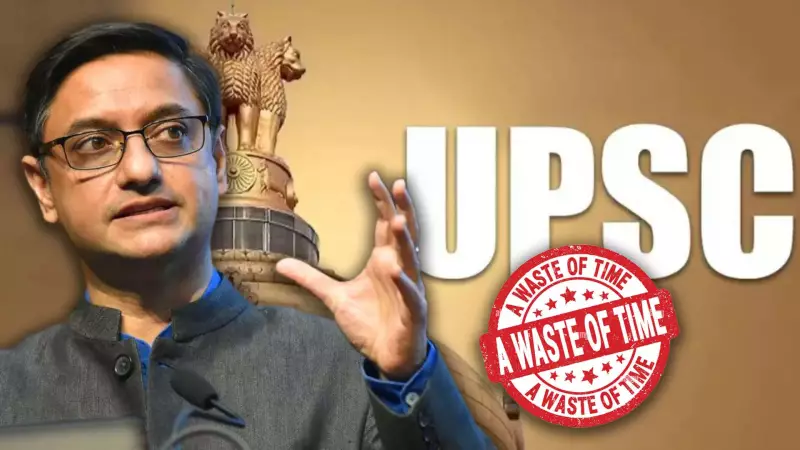
In a provocative statement that is set to ignite a nationwide debate on India's education and employment priorities, Sanjeev Sanyal, a key Economic Advisor to the Prime Minister, has labelled the relentless pursuit of the Union Public Service Commission (UPSC) examinations as "a complete waste of time." His remarks, made on December 30, 2025, challenge deep-seated aspirations for government job security, arguing that the rapid march of technology has fundamentally changed the rules of the game.
The AI Disruption: Making Traditional Education Obsolete?
Sanyal's core argument hinges on the transformative power of artificial intelligence and rapid technological advancement. He posits that traditional markers of academic achievement—including standardized exams like the UPSC, university degrees, and established curricula—are becoming increasingly irrelevant. According to him, AI can now deliver the most cutting-edge knowledge and information far more efficiently and dynamically than the rigid structures of current educational institutions.
"The world is changing at a pace our education system hasn't caught up with," Sanyal implied, suggesting that clinging to old models for the sake of perceived job security is a losing strategy. He emphasized that in the AI era, the ability to learn, unlearn, and apply skills in real-time will trump the possession of a static degree or the clearing of a one-time, notoriously difficult exam.

A Blueprint for Modern Learning: Skills and Apprenticeships
Instead of the traditional path, Sanyal passionately advocated for a seismic shift toward skill-based learning and hands-on apprenticeships. His vision encourages students to combine work with learning from an early stage, thereby gaining practical experience and market-relevant skills simultaneously. This model, he believes, would create a workforce that is agile, innovative, and better prepared for the demands of a modern economy.
Importantly, Sanyal clarified that he is not calling for the abolition of universities. He acknowledged their role but stressed an urgent need to modernize teaching methods and content to keep pace with technological evolution. Universities must transform from being mere degree-awarding bodies to hubs of continuous, applied learning.
Addressing the Social Fabric of Education
The advisor also tackled a common counter-argument in favor of traditional campus life—the invaluable social experience. Sanyal downplayed this concern, noting that structured social experiences within university walls have not been a historical prerequisite for personal or professional development. He suggested that meaningful social and professional networks can be built in various modern and dynamic environments beyond the conventional college campus.
Sanjeev Sanyal's comments are likely to resonate strongly with industry leaders and educational reformers who have long called for an overhaul of India's system. However, they are also poised to face significant pushback from those who see the UPSC as a venerable, merit-based gateway to national service and stability. This bold critique places the future of India's education policy and youth aspirations squarely at the center of a crucial conversation about adapting to an AI-dominated future.