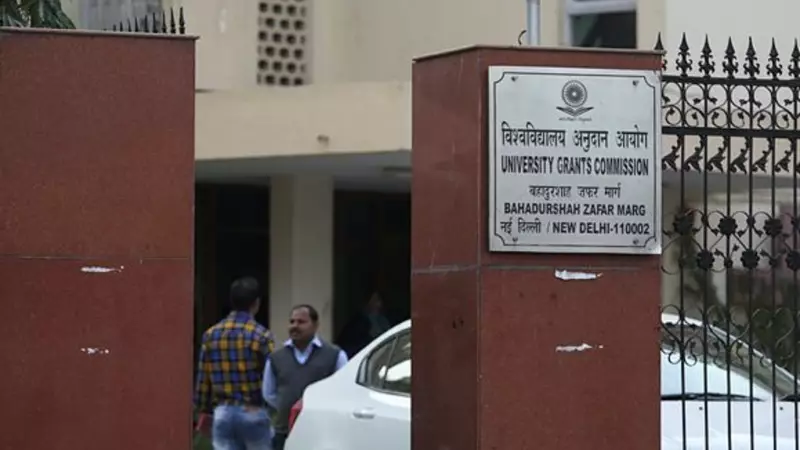
Supreme Court Petition Challenges UGC's 2026 Caste Discrimination Definition
A significant legal challenge has emerged against the University Grants Commission's recently notified regulations aimed at addressing caste-based discrimination in higher education institutions. A plea filed in the Supreme Court contends that the UGC's definition of caste discrimination is fundamentally flawed and exclusionary in nature.
Legal Challenge Against UGC Regulations
The petition, submitted by advocate Vineet Jindal, specifically targets regulation 3(c) of the UGC (Promotion of Equity in Higher Education Institutions) Regulations, 2026. The core argument presented is that the regulation adopts a non-inclusionary approach by defining caste-based discrimination strictly as discrimination against members of Scheduled Castes (SC), Scheduled Tribes (ST), and Other Backward Classes (OBC).
According to the plea, this limited definition effectively denies institutional protection and grievance redressal mechanisms to individuals belonging to general or non-reserved categories who may also face harassment or bias based on their caste identity. The petitioner argues that this creates an unconstitutional hierarchy of protection within educational institutions.

Constitutional Violations Alleged
The legal challenge raises serious constitutional concerns, alleging violations of multiple fundamental rights guaranteed by the Indian Constitution. The petition specifically cites:
- Article 14 - The right to equality before law and equal protection of laws
- Article 15(1) - Prohibition of discrimination by the State on grounds of religion, race, caste, sex, or place of birth
- Article 21 - The right to life and personal liberty, which includes the right to live with dignity
The petitioner contends that the current formulation of regulation 3(c) undermines these constitutional guarantees by creating differential treatment based on caste categories.
Demand for Caste-Neutral Definition
The plea urges the Supreme Court to take immediate action by restraining authorities from enforcing regulation 3(c) in its current form. More importantly, it seeks a judicial direction to redefine caste-based discrimination in what it describes as a caste-neutral and constitutionally-compliant manner.
Caste-based discrimination should be defined so that protection is accorded to all persons discriminated on the basis of caste, irrespective of their specific caste identity, the petition emphasizes. This approach would ensure that institutional safeguards extend to every student facing caste-based prejudice, regardless of their social category.
Immediate Relief Sought
Pending formal reconsideration of the definition, the petition has sought interim directions to both the Union government and the UGC. These directions would require that all mechanisms established under the new regulations - including Equal Opportunity Centres, Equity Helplines, and Ombudsperson frameworks - be made available to all students in a non-discriminatory manner.
Student Protests and Campus Concerns
The legal challenge comes amid growing student unrest regarding the new regulations. Students have called for a protest outside the UGC headquarters in Delhi, expressing concerns that the regulations could lead to chaos on university campuses. Protest organizers have appealed for unity from the student community, urging them to gather in large numbers to register their opposition.
Alokit Tripathi, a PhD student from Delhi University, voiced serious apprehensions about the practical implementation of these rules. The new regulations are draconian in nature. The definition of victim is already predetermined. Victim can be anyone on the campus, Tripathi told PTI, highlighting concerns about procedural fairness and the burden of proof shifting onto the accused.

Mixed Reactions from Student Groups
While general category students have expressed strong opposition to the regulations, the All India Students' Association, a Left-backed student group, has released a statement supporting the UGC Equity Regulations, 2026. The group welcomed the inclusion of OBCs within the ambit of equity protection but raised concerns about representation in Equity Committees and the abstract definition of discrimination.
The statement noted that representation of SC, ST, OBC and women in the Equity Committee, both among faculties and students, remains low, vague and inadequately defined. It further criticized the regulations for defining discrimination in broad terms without enumerating concrete acts or instances of discrimination.
Broader Implications for Higher Education
The UGC regulations, notified on January 13, 2026, represent a significant attempt to address caste-based discrimination in colleges and universities across India. The framework requires institutions to establish special committees, helplines, and monitoring teams specifically designed to handle complaints, with particular focus on SC, ST, and OBC students.
While the government maintains that these changes aim to bring greater fairness and accountability to higher education institutes, critics fear they may inadvertently deepen social divisions and create new challenges on university campuses. The Supreme Court's eventual ruling on this petition will likely have far-reaching implications for how educational institutions address caste discrimination and implement equity measures in the coming years.