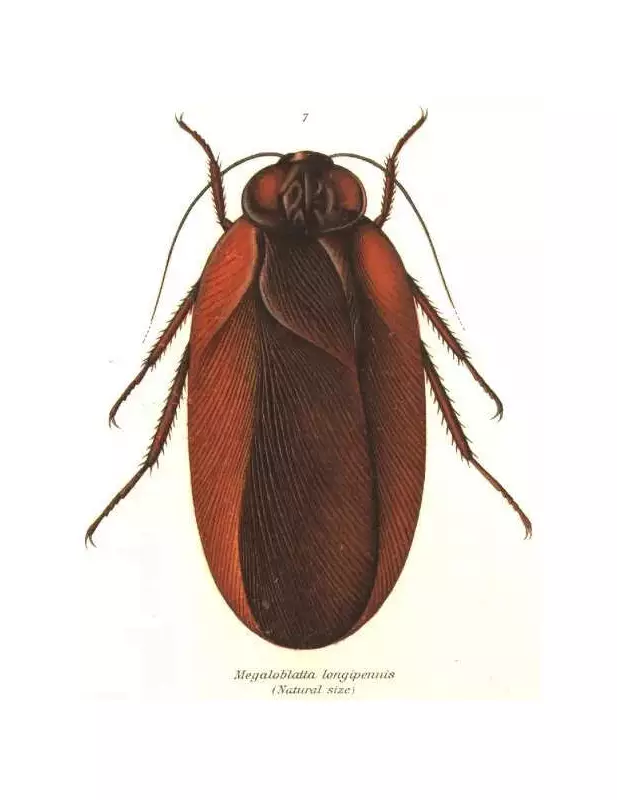
In the dense, humid rainforests of Central and South America, a true giant of the insect world quietly thrives. This is Megaloblatta, a genus of cockroaches renowned for its extraordinary size and fascinating biology. For over a century, these remarkable insects have captivated scientists who continue to unravel the secrets of their evolution, behaviour, and crucial ecological role.
Record-Breaking Dimensions and Scientific Classification
According to the Guinness World Records, the title for the world's largest winged cockroach belongs to Megaloblatta longipennis. This species calls the tropical forests of Peru, Ecuador, and Panama home. The record is held by a preserved female specimen from a collection in Yamagata, Japan, which measures a staggering 97 mm (3.8 inches) in length and 45 mm (1.75 inches) in width. Even more impressive is the potential wingspan, which can stretch up to 20 cm (8 inches). To put this in perspective, most common cockroaches are a mere 0.6 to 7.6 cm long.
Scientifically, Megaloblatta is classified within the animal kingdom (Animalia) and the arthropod phylum (Arthropoda). It belongs to the class Insecta and the order Blattodea, which includes all cockroaches. Further down the taxonomic tree, it sits in the superfamily Blaberoidea and the family Ectobiidae (formerly known as Blattellidae). Within this family, it is part of the Nyctiborinae subfamily, groups typically known for being nocturnal forest dwellers. The genus was first described by the German entomologist Heinrich Dohrn in 1887.

A History of Discovery and Unique Defences
The name Megaloblatta itself derives from Greek words meaning "large cockroach," a fitting description. Dohrn established the genus based on specimens from Peru and Panama. Early research was sometimes muddled, with confusion between Megaloblatta and the genus Blabera. However, the work of entomologists like American researcher Morgan Hebard in 1920 helped clarify the classification and distribution of these insects through extensive fieldwork in Panama and the Amazon.
Beyond just size, Megaloblatta exhibits intriguing behaviours. A key discovery in 1982 revealed that nymphs (young) of the species Megaloblatta blaberoides can produce a loud defensive noise by rubbing parts of their abdomen together to scare off predators. This sound production became an important characteristic for distinguishing between different species within the genus.
Anatomy, Appearance, and Sexual Differences
Physically, these cockroaches have an elongated, flattened body ideal for navigating tight spaces under bark and leaf litter. They possess a large pronotum that shields the head, strong spiny legs for rapid movement, and two pairs of wings. The forewings are tough and protective, while the hind wings are membranous, enabling short flights or glides. Their long antennae and large compound eyes are perfect for sensing the dark forest environment at night.
Sexual dimorphism is pronounced in Megaloblatta. Males generally have longer wings, aiding their mobility in the forest canopy. Females are broader with larger abdomens, adapted for carrying egg cases (oothecae). Size can vary with habitat; individuals from lush, wet regions like the Amazon tend to be larger. While some species, like Megaloblatta insignis, are relatively small at around 4 cm, others, like the record-holding Megaloblatta longipennis, are veritable giants of the insect realm.
Ongoing research continues to shed light on these incredible insects, reminding us that even the most misunderstood creatures play a vital part in the complex tapestry of the rainforest ecosystem.