AI Integration in Senior School Studies: Mainstream Yet Not Dominant
Artificial Intelligence has seamlessly woven itself into the daily academic routines of senior secondary students, becoming a mainstream tool, though not yet a dominant force. Its influence extends beyond mere homework assistance, significantly impacting how a segment of teenagers manages academic stress and pressure.
Widespread Adoption and Usage Patterns
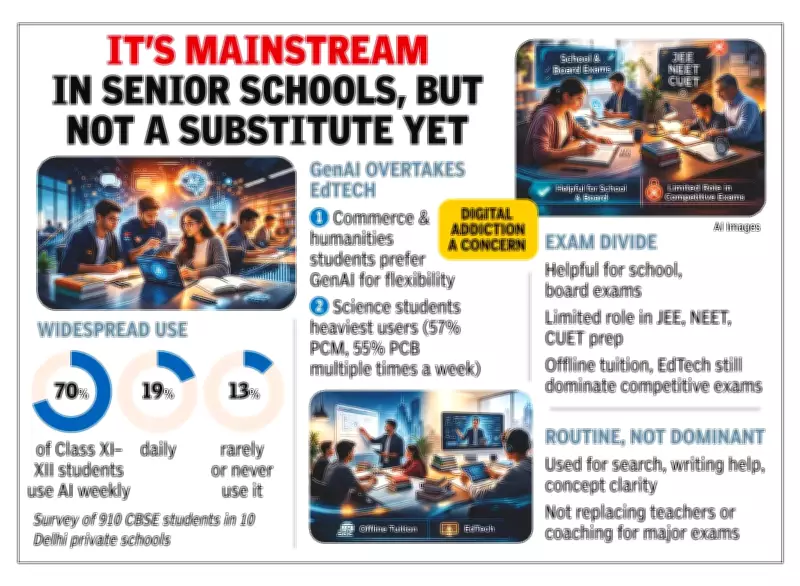
According to a recent study conducted by the Centre for Policy Research and Governance (CPRG), an institution recognized by the Indian Council of Social Science Research (ICSSR), nearly 70% of Class XI and XII students utilize AI tools at least once a week. This includes a notable 19% who engage with AI on a daily basis. The survey, which involved 910 CBSE students from 10 private schools in Delhi, highlights that AI has firmly entrenched itself in routine academic practices. Only 13% of respondents reported rare or no usage, making non-use the exception rather than the norm.
Stress-Related AI Use and Mental Health Implications
The study uncovers early mental health concerns emerging alongside AI's rapid integration. A significant minority of students have turned to AI during periods of stress and pressure, with around one-third admitting to such behavior and nearly one in five reporting regular stress-related use. This aligns with warnings from the Economic Survey 2025-26, which flagged digital addiction among children and youth as a growing threat to learning outcomes. The survey emphasized that excessive digital exposure undermines attention, motivation, and emotional well-being, shifting focus from access to behavioral health considerations.

Generative AI Overtakes Conventional EdTech
Generative AI tools are increasingly surpassing traditional EdTech platforms in daily academic use, particularly among commerce and humanities students. These students report higher frequency of use with generative AI compared to exam-focused apps, citing benefits like flexibility and instant access. The report notes, "Generative AI tools are incorporated into everyday study practices across disciplines." However, science students remain the heaviest users, with 57% of PCM and 55% of PCB students using AI multiple times a week or more.
Primary Uses and Limitations
AI is most commonly employed for searching academic information, with 55% of students reporting frequent use, followed by writing assistance at 44%. In contrast, 58% rarely use AI for personalized study planning. Importantly, students maintain a clear boundary regarding high-stakes examinations. While over half find generative AI helpful for school and board exams, its utility drops sharply for competitive entrance tests like JEE, NEET, and CUET, where offline tuition and structured EdTech platforms continue to dominate preparation.
Expert Insights and Future Directions
CPRG founder-director Ramanand emphasized that the findings debunk myths about technology dependency, revealing that students still value human interaction and use AI primarily for basic information, which they then verify with people. He advocated for building societal capabilities through technology rather than fostering dependence. Warning against technological fear, Ramanand added that AI largely affects routine, repetitive jobs and stressed the necessity of reskilling, treating technology as a tool, not a threat.
Conclusion: A System in Transition
Collectively, the findings depict an education system in flux, where AI is mainstream but serves as a supplement rather than a substitute. As concerns around learning outcomes and student well-being intensify, the integration of AI continues to evolve, balancing innovation with caution in academic environments.