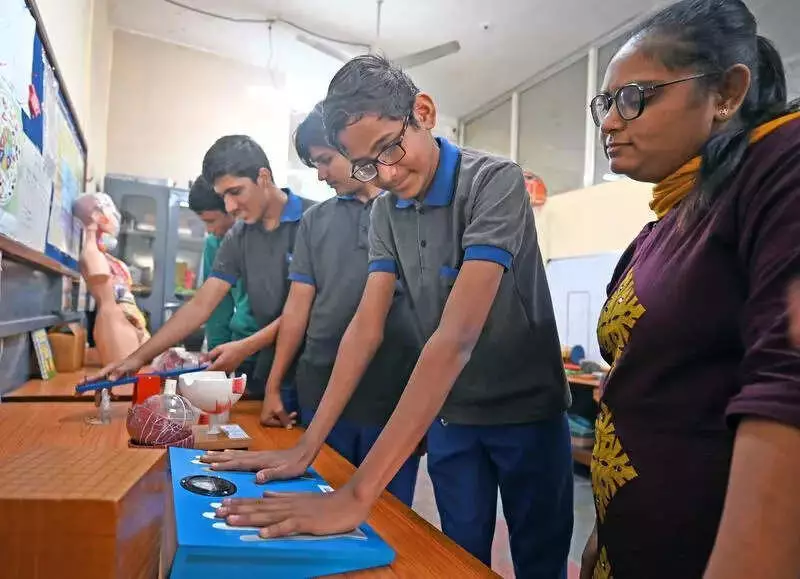
In a quiet corner of Ahmedabad, a silent educational revolution is taking shape. At the Minnie Cama Secondary & Higher Secondary School for the Blind, located within the Blind People's Association (BPA), students like 16-year-old Sujal Dudhrejiya are tackling complex mathematical concepts, such as calculating the area of a cone, using innovative methods.
Overcoming Challenges with Tactile Learning
Sujal, a Class 10 student originally from Bhavnagar, is one of only four students in his class of twenty who has chosen mathematics this year. The majority still opt for music, a trend that highlights the historical difficulty of teaching technical subjects to the visually impaired. Nikita Patel, a teacher at the school, explains that students often struggle to grasp abstract concepts. To bridge this gap, educators have devised novel teaching techniques that combine auditory clues, Braille writing, and tactile models.
"A single sum or problem can take more than 30 minutes," Patel says, describing the process used for geometry, algebra, and logic topics like probability. Sujal, who aspires to become a software engineer or coder, acknowledges the challenge. "I would not say that it is one of the easiest subjects, but it is not the toughest either. We learn about shapes, radius, area, etc., through deconstructing the models," he shares.

A Policy Push for Inclusion and Parity
This shift towards STEM subjects coincides with significant policy changes aimed at integrating students with disabilities into the mainstream. The timing is poignant as January 4 is celebrated globally as Braille Day, marking the birth anniversary of Louis Braille.
Officials from the Gujarat Secondary and Higher Secondary Education Board (GSHSEB) note a slow but steady rise in the number of visually impaired students opting for the Class 12 science stream, with about 7 to 10 students making this choice annually. A landmark notification from the state education department on December 22 of last year has further leveled the playing field.
The new rules introduce several key provisions:
- Students can now opt for different writers for different subjects and are permitted to use a computer during exams.
- They are granted 20 minutes of extra time per exam hour.
- Practical exams are replaced with MCQ-based tests of equal marks.
- The use of certified reader devices and computers with Braille software is allowed, provided they are submitted to the exam centre three days prior.
"The move is to ensure that candidates with disabilities can appear for the exam and choose the same opportunities that the other candidates get," a senior GSHSEB official stated, emphasizing that the new provisions aim to provide parity.
Building Dreams with the Right Tools
Back at the BPA lab, the impact of hands-on learning is evident. Gaurav Zala, a Class 9 student, minutely examines models explaining inertia. "We learnt fractions through strips with different sizes and markers," he says. His sentiment echoes a growing confidence among his peers: "If we get the right educational aids and tools, I am sure we can also achieve our dreams to pursue technical courses."
This combination of grassroots innovation in teaching—through dedicated maths and science labs—and supportive top-down policy reform is creating a new pathway. It is empowering a generation of visually impaired students in Gujarat to look beyond traditional choices and aim for careers in technology, engineering, and science, turning perceived limitations into achievable dreams.