CBSE Unveils Comprehensive Schedule for Class 10 Second Board Exam 2026 LOC Submission
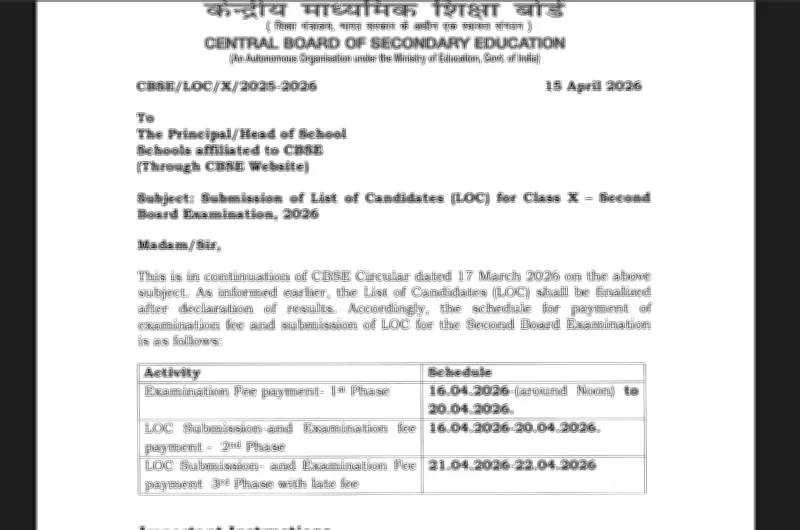
The Central Board of Secondary Education (CBSE) has officially published a detailed and comprehensive schedule for the submission of the List of Candidates (LOC) for the upcoming Class 10 Second Board Exam in 2026. This announcement marks a critical phase in the examination process, with the board linking the LOC procedure directly to the declaration of results, thereby creating a tightly constrained timeline for completing all necessary formalities.
Structured Submission Phases with Penalty Windows
The CBSE has delineated a clear three-phase submission process. The initial phase for fee deposit and LOC submission is scheduled to commence at noon on April 16, 2026, and will conclude on April 20, 2026. A second phase overlaps with these same dates, providing an additional window for compliance. For those who miss these deadlines, a final submission window has been established from April 21 to April 22, 2026, which will incur significant late fee penalties, emphasizing the board's strict adherence to timelines.
Eligibility Criteria: Inclusions and Exclusions
The circular issued by CBSE explicitly defines who can apply and who is barred from participation. Students who failed to register during the first LOC phase are now permitted to submit their names, while those already registered must ensure timely fee payment within the stipulated period. Candidates who previously opted in but now wish to withdraw are allowed to do so. However, the board has instituted a firm restriction: students categorized under 'Essential Repeat' (ER) are strictly prohibited from appearing in the second examination.

For compartment candidates, the rules remain nuanced and specific. These students have options available either under the same category or for performance improvement, but their LOC process will be managed exclusively by their respective individual institutions, not directly through the central board portal.
Subject Flexibility and Improvement Opportunities
In a significant move, CBSE has granted students the flexibility to switch from Mathematics (Standard) to Mathematics (Basic) for their second attempt. This adjustment is designed to accommodate varying academic needs and preparedness levels. However, the board has drawn a definitive line regarding other subjects; no changes will be permitted beyond Mathematics, reinforcing the examination's focus on structured, targeted improvement rather than allowing wholesale subject reshuffling.
Furthermore, candidates who have already appeared and cleared the main examination will be provided an opportunity to enhance their scores in up to three core subjects. These subjects include Science, Mathematics, Social Science, and Languages, offering a pathway for academic betterment. The second test will be based entirely on the syllabus of the main board examination for 2026, ensuring no ambiguity regarding content and maintaining academic consistency.
Fee Structure and Digital Payment Mandate
The fee framework established by CBSE reflects a clear penalty structure for delays. For candidates within India, the normal fee is set at Rs. 320 per subject, totaling Rs. 960 for three subjects. This amount escalates steeply to Rs. 3,300 under late fee conditions. International candidates face even higher costs, with fees reaching Rs. 6,600 for three subjects, plus an additional late fee penalty of Rs. 2,000 per candidate if deadlines are missed.
In a decisive shift towards digitalization, CBSE has mandated that all dues must be paid exclusively through digital means. Acceptable methods include debit cards, credit cards, UPI, NEFT, RTGS, or net banking. The board has explicitly stated that no offline transactions, including direct bank transfers, will be entertained under any circumstances. Applications associated with offline payments will not be accounted for and will be disallowed, underscoring the importance of adhering to the digital payment protocol.