Chandigarh Administration Prepares Supreme Court Challenge on Teachers' Retirement Age
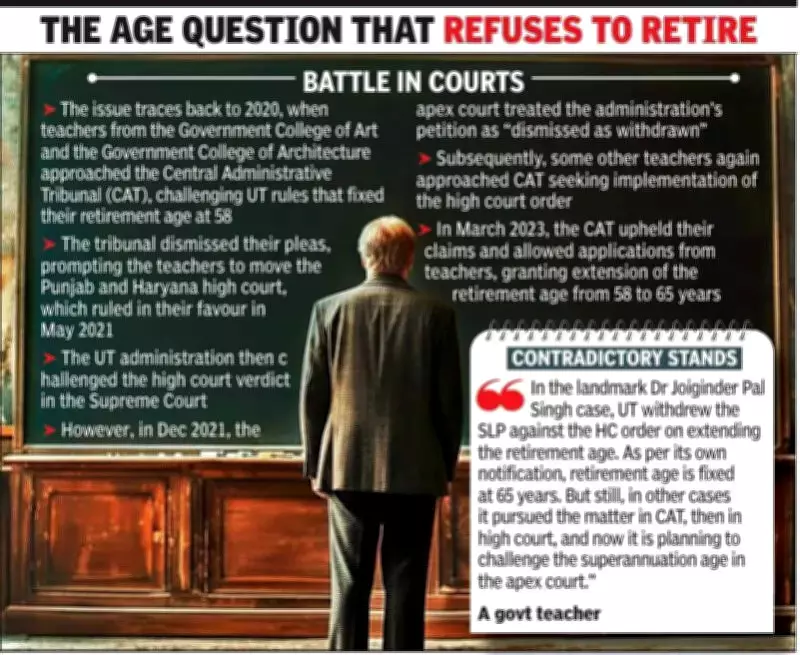
The Chandigarh administration is poised to approach the Supreme Court regarding the settled issue of retirement age for government teachers. In a significant reversal of its previous position, the administration is actively considering challenging the extension of superannuation age for government teachers to 65 years.
Potential Reignition of Long-Standing Dispute
If the administration proceeds with an appeal against the Punjab and Haryana High Court order, it could reignite the protracted legal battle over retirement age for teachers and faculty in government colleges directly administered by the Chandigarh administration. This includes institutions such as Postgraduate Government Colleges in Sectors 11, 42, and 46, along with other Union Territory-run institutions affiliated with Panjab University.
Landmark Legal Precedents and Judgments
The legal foundation for the current retirement age was established through several key cases:

- Dr. Joginder Pal Singh Case (2021): A division bench of the Punjab and Haryana High Court permitted petitioners to continue in service until age 65, with potential extensions up to 70 years as per regulations. The court mandated reinstatement of forcibly superannuated teachers and granted all consequential benefits within two months.
- Subsequent Legal Developments: This landmark judgment established that AICTE norms (retirement at 65) supersede older 1992 Punjab-based rules for technical and arts college faculty. The precedent was frequently cited in later cases involving general government college teachers under UGC norms.
- 2023 and 2025 Rulings: The judgment was heavily relied upon in 2023 CAT orders and the September 2025 Punjab and Haryana High Court judgment, which upheld the extension to 65 years for broader government college teachers, noting "no differentiating factor" from the Dr. Joginder Pal Singh case.
Regulatory Framework and Service Rules
On March 29, 2022, the Union Ministry of Home Affairs notified the Union Territory of Chandigarh Employees (Conditions of Service) Rules, 2022. These rules, published in the Chandigarh e-gazette on March 30, 2022, took effect from April 1, 2022, and explicitly aligned service conditions for Chandigarh administration employees with those under the Central Civil Services of the Government of India for Group A, B, and C posts.
"For higher education faculty, this adoption automatically invoked UGC Regulations 2010 and 2018, which prescribe a uniform superannuation age of 65 years for teachers in universities and colleges. This promotes retention of experienced faculty and aligns with central institutions," explained a UT official requesting anonymity.
Contradictions in Administrative Stance
Questions are emerging regarding the administration's latest move, which appears to contradict its own established position. "In the landmark case, UT withdrew the Special Leave Petition against the Punjab and Haryana High Court order extending retirement age. According to its own notification, retirement age is fixed at 65 years. Yet, in other cases, it pursued the matter through CAT, then the high court, and now plans to challenge superannuation age in the apex court. Employees are already serving under the settled law of 65-year retirement age," stated a government teacher who requested anonymity.
A UT official clarified, "The matter remains under consideration. All aspects of the issue are being examined, including the question of arrears."
Broader Implications and Context
The potential Supreme Court challenge represents a significant development in education policy and employment regulations within the Union Territory. The administration's reconsideration of a previously settled legal matter could have far-reaching consequences for:

- Current and retired government teachers' service conditions
- Institutional stability in UT-administered colleges
- Alignment with national education policies and UGC regulations
- Future recruitment and retention of experienced faculty members
The administration's final decision will determine whether this long-standing issue receives renewed judicial scrutiny at the highest level, potentially affecting educational institutions across Chandigarh and setting precedents for similar cases nationwide.