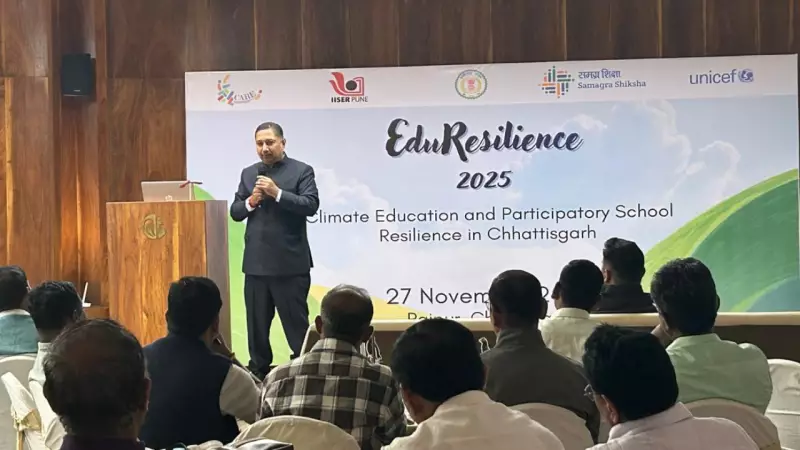
Education stakeholders from across Chhattisgarh gathered in Raipur on November 27, 2025, for a significant state-level summit focused on preparing schools for climate challenges. The EduResilience 2025 event brought together government officials, academic experts, and international development organizations to address the urgent need for climate-resilient education systems.
Key Participants and Collaborative Efforts
The summit witnessed participation from over 70 Block Resource Coordinators representing various regions of Chhattisgarh. These officials play a crucial role in supporting schools, facilitating teacher development, and implementing educational programs at the grassroots level.
This important initiative forms part of the collaborative effort led by IISER Pune through their Communicating Action and Resilience for Environmental Health (CARE) Project. The project is being implemented in partnership with Samagra Shiksha Chhattisgarh and UNICEF, aiming to provide schools with essential knowledge and tools to respond effectively to climate-related risks while enhancing preparedness among both students and educators.

Emphasis on Climate Resilience in Education
During the keynote session, Dr. M. Sudhish, Head of the State Pedagogy Cell at Samagra Shiksha Raipur, delivered a powerful message about the necessity of climate resilience in schools. He emphasized that building climate resilience has transitioned from being optional to becoming "foundational to safeguarding learning continuity and wellbeing" in educational institutions.
Dr. Shalini Sharma, Associate Professor at IISER Pune and Lead of the CARE Project, highlighted the project's broader vision. She explained that integrating climate-responsive thinking and experiential learning into school ecosystems represents more than just educational reform—it honors "a fundamental child right: the right to a liveable future." Dr. Sharma further elaborated that their approach goes beyond traditional teaching methods, focusing on equipping children with practical knowledge that enables meaningful action.
Practical Demonstrations and Future Roadmap
The summit featured an engaging multi-stakeholder panel discussion with representatives from Samagra Shiksha, UNICEF, and IISER Pune. Panelists addressed specific strategies for embedding climate education and resilience practices into both school governance structures and daily pedagogical approaches.
Vishal Vasvani, Emergency Officer at UNICEF, characterized the summit as "an important and promising step toward strengthening climate-resilient education" while underscoring UNICEF's commitment to ensuring children can continue learning safely despite climate-related disruptions.
Participants engaged in hands-on activities focused on interpreting critical climate data, including rainfall patterns and temperature trends. Science education practitioners Ashok Rupner and Ankish Tripude from the Science Activity Centre at IISER Pune led practical demonstrations showcasing activity-based learning approaches specifically designed for government school environments.
Organizers confirmed that EduResilience 2025 represents a foundational step toward developing a long-term framework to enhance climate literacy and resilience for children throughout Chhattisgarh, with particular focus on those residing in climate-sensitive and high-risk regions of the state.