Gurgaon School's Affiliation Scam Leaves Class X Students in Exam Limbo
The bizarre ordeal of nine Class X students in Gurgaon has exposed a troubling trend in the education sector, where institutions engage in questionable partnerships to bypass mandatory affiliations and profit at the expense of students' futures. These students, who spent an entire academic year studying the CBSE syllabus, were abruptly forced to sit for Haryana board exams at the last minute after their school's informal arrangements collapsed.
How Educrest International Operated Without Proper Affiliation
Educrest International, the school in question, ran a Class X batch without obtaining CBSE affiliation, collecting full fees in advance from parents. To circumvent this lack of authorization, the school relied on informal tie-ups with CBSE-affiliated institutions to secure admit cards for its students. However, when these arrangements fell through for a portion of the batch, nine students were left unregistered and effectively barred from taking the CBSE board exams.
Out of the 25 students in Class X at Educrest, 14 managed to receive admit cards through other affiliated schools, but the remaining 11 could not be "accommodated" before the registration deadline. This resulted in no registration, no admit cards, and no access to the CBSE exams. The parents of nine of these affected students moved the Punjab and Haryana High Court, which intervened earlier this week and ordered that they be allowed to write their Class 10 board exams under the state board. They wrote their first paper on Thursday.

A Widespread and Risky Practice in Education
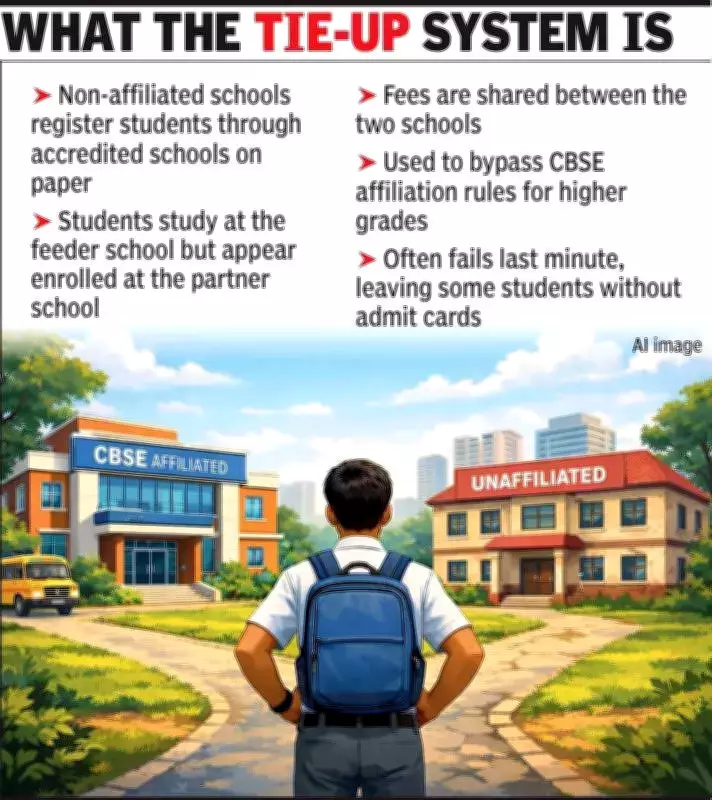
Education officials have confirmed that this incident is not an isolated administrative lapse but rather a symptom of a broader, hazardous practice. Unaffiliated schools often operate senior classes by using "third-party" affiliations, where students are officially enrolled at an accredited institution on paper but taught elsewhere. This shadow system has been operational for years, with unaffiliated schools collecting full tuition and examination fees from unsuspecting parents, only to later "sell" these students to larger, CBSE-accredited schools for registration.
The process is highly calculated and begins years before board exams. Many schools can legally function up to Class 8, where CBSE scrutiny is less stringent. The critical juncture arrives in Class 9, when the Board requires student registration and candidate lists, initiating a verification cycle that culminates in the Class 10 exams. If students are not properly registered in time, last-minute solutions become nearly impossible.
Previous Cases and Official Responses
A similar case emerged in Gurgaon in February last year, when three students of Orchids International School in Sector 49 were initially denied admit cards and missed their first English paper due to CBSE affiliation and documentation delays. After parents protested, the Delhi High Court intervened, and hall tickets were issued.
CBSE chairperson Rahul Singh has stated that such arrangements are strictly prohibited and can invite severe action, including de-affiliation of involved schools. "This is simply not allowed. If we find a school indulging in it, it is liable to be de-affiliated," he emphasized.
School Owner's Explanation and Parental Outcry
Educrest owner Vinay Kataria revealed that the school had been operating for eight years but never received CBSE affiliation for classes 9 and 10. "We had permission up to Class 8. So, we applied for affiliation for classes 9 and 10. But during an inspection, some rooms were under construction, which is why our file was rejected," he explained.
Kataria admitted that Educrest previously had a tie-up with a Delhi-based CBSE-affiliated institution, which enabled last year's Class X students to take the CBSE boards. "This year, it did not work out because the Delhi school got de-affiliated. Some affiliated schools agreed to register a limited number of outside students, so 14 got their admit cards. But the remaining students could not be accommodated before the deadline. They were left unregistered and did not receive hall tickets," he added.

Parents expressed deep frustration, arguing that the collapse of this system has unfairly burdened their children. "The last-minute change has caused immense mental stress. They were already anxious about exams, and the uncertainty only added to the pressure. We want accountability. Schools cannot play with the future of students by keeping parents in the dark about affiliation issues," said one parent who approached the High Court.
Another parent echoed these sentiments, stating, "We felt completely helpless when exams began and our children were not allowed to sit because of an affiliation dispute that was never clearly explained to us. The fault is not the students', yet they were the ones made to suffer."
Officials noted that CBSE typically intervenes only when specific complaints are filed, as there is no automatic mechanism to detect such discrepancies. This case underscores the urgent need for stricter oversight and transparency in school affiliations to prevent similar incidents in the future.