Indian Students Exhibit High Interest in Astronomy but Struggle with Core Concepts
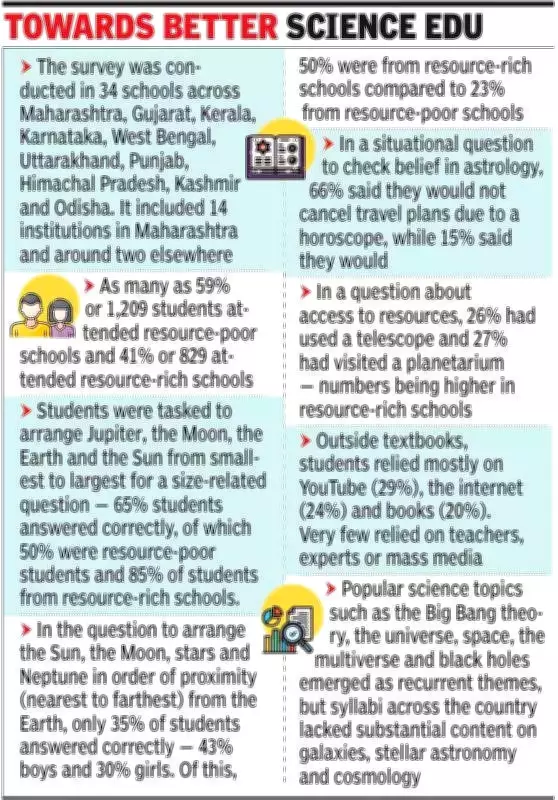
A comprehensive baseline survey conducted across India to evaluate astronomy learning in schools has uncovered a significant gap between student enthusiasm and their understanding of fundamental principles. The study, which involved 2,038 Class IX students from 10 states, found that while a majority expressed a strong interest in the subject, many demonstrated limited awareness of basic astronomical concepts.
Survey Highlights and Key Findings
The survey revealed that nearly 86% of the students reported enjoying learning about astronomy, and 70% were considering studying it in the future. However, access to essential resources such as telescopes and planetariums was found to be severely limited, particularly in resource-poor schools. This lack of infrastructure hampers practical learning and engagement with the subject.
Aniket Sule, Manager of the International Astronomical Union's Office of Astronomy for Education (IAU-OAE) India Centre and a co-author of the study, emphasized the importance of the findings. "It is probably the first large-scale national assessment of astronomy learning in Indian schools. The results indicate the valuable opportunity and an urgent need to strengthen astronomy education in India," he told reporters.

Research Methodology and Objectives
The study was conceptualized by the IAU-OAE India Centre and jointly hosted by the Inter-University Centre for Astronomy and Astrophysics (IUCAA) in Pune and the Homi Bhabha Centre for Science Education (HBCSE-TIFR) in Mumbai, in collaboration with various institutes across India. Lead author Moupiya Maji, a former post-doctoral fellow at IUCAA, explained that the research focused on critical questions.
"We examined the extent to which students internalized astronomy content in the syllabus, their expectations, ability to connect knowledge with daily lives or cultural heritage, and differences based on gender and socio-economic status," Maji said. "Such data is essential if science education reforms are to be evidence-based, rather than driven by assumption."
Challenges and Recommendations for Improvement
Associate professor at IUCAA and deputy manager of IAU-OAE, Surhud More, highlighted two crucial steps to address the issues identified. First, textbooks must explain fundamental astronomy concepts in simple terms, considering the diverse mental models students already possess. For instance, astronomical reasons behind observable sky phenomena are often not explicitly addressed.
"We need to engage with children and guide them to reason their way towards correct scientific explanations," More stated. Second, teacher training is vital. "Astronomy education must be integrated into teacher training programmes to ensure concepts are taught accurately, as many teachers hold misconceptions. We must nurture students' curiosity by improving access to observational resources, telescopes, planetariums, and sky-watching opportunities—not just in private or well-resourced schools, but down to the village-level government schools," he added.
The survey underscores a pressing need for systemic reforms in astronomy education across India, leveraging student interest to build a stronger foundation in scientific understanding.