Karnataka Implements New Textbook Distribution System for Pre-University Colleges
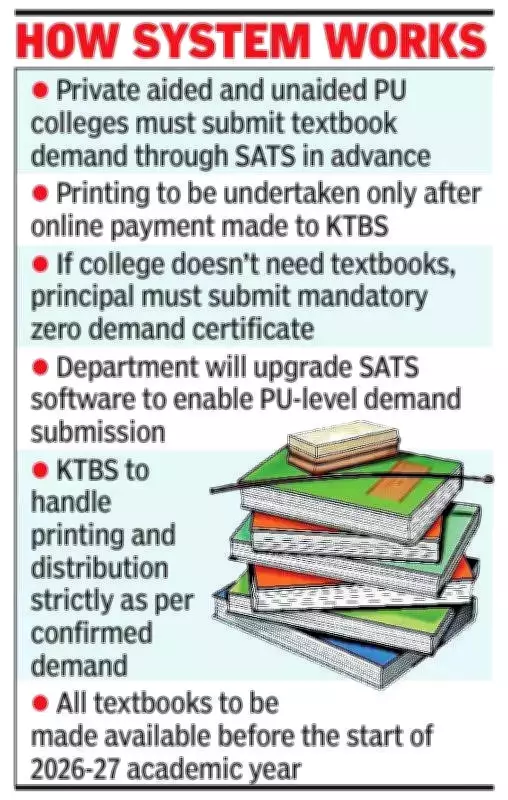
The Department of Pre-University (PU) Education in Karnataka has announced significant changes to the printing and distribution of textbooks for private aided and unaided PU colleges. Starting from the 2026-27 academic year, these institutions will be required to make advance payments and submit their textbook demands online through a centralized portal.
New Mandatory Procedures for Textbook Procurement
Under the revised guidelines, educational institutions must submit detailed textbook requirements through the Student Achievement Tracking System (SATS) portal. The submission must include class-wise, subject-wise, and title-wise specifications. Crucially, the printing and supply of textbooks will commence only after the prescribed amount, as fixed by the Karnataka Textbook Society (KTBS), is paid in advance via an online payment gateway.
This shift marks a departure from the previous system, where books were printed based on broader estimates rather than precise demand. The new approach aims to streamline the procurement process and ensure that textbooks are available according to actual student needs.

Addressing Wastage and Financial Challenges
The decision to overhaul the textbook distribution system follows observations from previous academic years. Officials noted that only approximately 40% of the total student strength in PU colleges sought textbooks through official channels. Despite this low uptake, books were printed in large quantities, leading to a surplus of unsold copies stored in warehouses.
Bharath Selvan, Director of PU Education, explained: "Until now, we were not getting the exact requirements of students. So, sometimes what they required was not available for purchase, and in some cases, printing was in excess of demand. The new process has been initiated for aided/unaided PU colleges so that actual requirements can be obtained and the same printed and provided."
This surplus stock created significant financial problems for KTBS, as many PU students opted to purchase NCERT textbooks from the open market instead of through their colleges. The wastage of resources and unnecessary financial burden prompted the state government to adopt a demand-based system, similar to the one already in place for private schools from classes 1 to 10.
Expected Benefits and Future Implications
The implementation of this new system is expected to bring several benefits:
- Reduced Wastage: By printing textbooks based on actual demand, the government aims to minimize surplus stock and associated storage costs.
- Financial Efficiency: Advance payments will help KTBS manage its finances more effectively, avoiding losses from unsold books.
- Improved Availability: Students are likely to have better access to required textbooks, as the system ensures that printing aligns with precise needs.
- Streamlined Process: The online submission through the SATS portal is designed to simplify and standardize the demand collection process across institutions.
This policy change reflects a broader trend in educational administration towards data-driven decision-making and resource optimization. By aligning textbook production with actual student demand, Karnataka aims to create a more sustainable and efficient educational ecosystem for its pre-university colleges.