Maharashtra Government Moves to Regulate Private Tuition Classes with New Draft Law
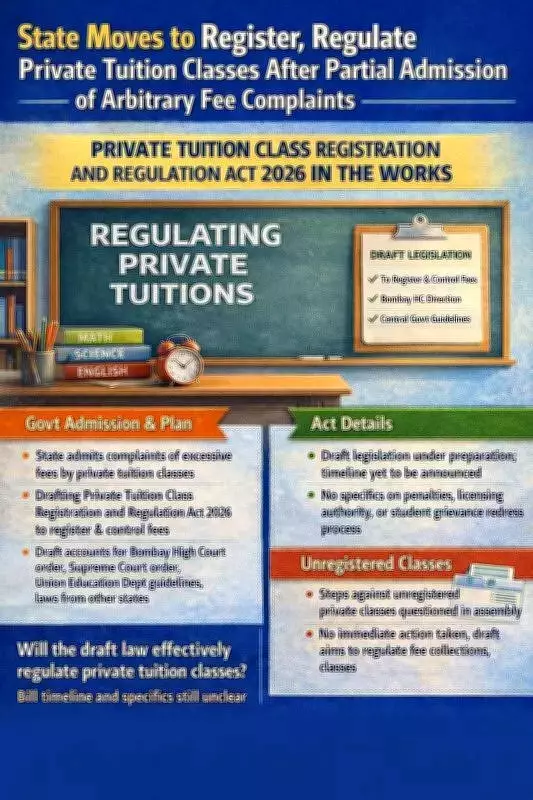
The Maharashtra state government has formally acknowledged numerous complaints regarding private tuition classes allegedly charging excessive fees from students and their families. In response, authorities have confirmed that a comprehensive law to regulate this sector is currently being drafted. This development was announced in the Maharashtra legislative assembly on Friday by School Education Minister Dada Bhuse.
Minister Announces Private Tuition Class Registration and Regulation Act
During the assembly session, Minister Dada Bhuse revealed that the government is actively preparing the Private Tuition Class Registration and Regulation Act. This legislative initiative aims to bring much-needed oversight and standardization to the burgeoning private tuition industry across the state. The minister emphasized that the draft is in its finalization stages, drawing from a wide array of inputs and precedents.
The draft legislation incorporates multiple critical sources, including:

- A Bombay High Court order issued in response to a petition filed by the Forum for Fairness in Education.
- A Supreme Court of India order from a plea submitted by Sukdev Saha.
- Guidelines released by the Union Higher Education Department in January 2024.
- A detailed proposal put forward by the Maharashtra Commissioner of Education.
- Regulatory frameworks and models already adopted by various other Indian states.
Assembly Debate Highlights Concerns Over Unregistered Centers and High Fees
The issue was brought to the forefront in the assembly by Risod MLA Ramdas Masram, who raised pointed questions about the government's actions against unregistered coaching centers. Masram specifically inquired about measures taken against centers operating without official approval and those imposing disproportionately high fees on students. He further sought clarity on whether the government intends to introduce legislation specifically designed to curb arbitrary and unregulated fee collection practices.
In his reply, Minister Bhuse confirmed that the draft law is being meticulously finalized to address these very concerns. However, he did not provide a specific timeline for when the proposed legislation would be formally introduced in the state legislature or subsequently enforced. The minister's statement also left several key operational details unspecified.
Unanswered Questions on Penalties, Licensing, and Grievance Redressal
Significantly, the announcement did not include details on several crucial aspects of the proposed regulatory framework. Minister Bhuse did not specify the proposed penalty structure for violations by tuition centers. It remains unclear whether the government plans to establish a dedicated licensing authority to oversee registration and compliance. Furthermore, the mechanism for addressing student and parent grievances related to fee disputes or service quality was not elaborated upon.
This legislative move comes amid growing public concern over the commercialization of supplementary education and the financial burden it places on families. The proposed act represents a significant step toward formalizing and controlling a sector that has largely operated without uniform state-level regulation in Maharashtra.