Nagpur Parents and Educators Challenge State's Uniform School Calendar Amid Scorching 44°C Heatwave
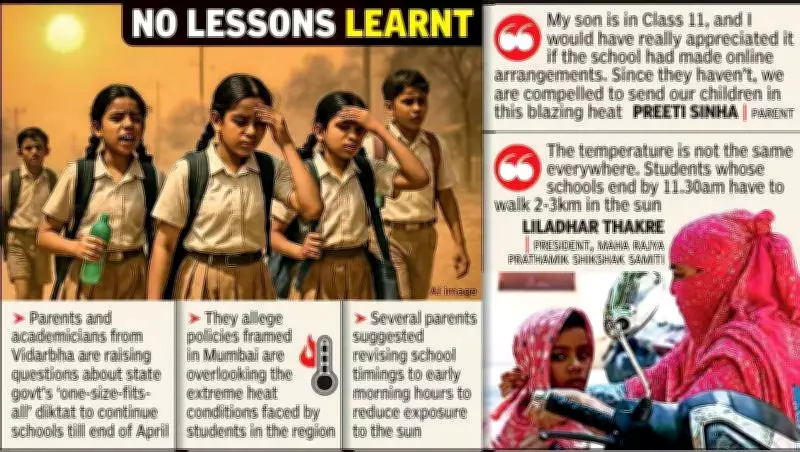
As temperatures in Vidarbha soar beyond 44°C, starkly contrasting with Mumbai's relatively moderate 35°C, parents and academicians from the region are vocally questioning the Maharashtra state government's 'one-size-fits-all' directive to keep schools operational until the end of April. They allege that policies formulated in the state capital are blatantly overlooking the extreme heat conditions endured by students in this region, creating a hazardous academic environment.
Parental Anguish Over Academic Pressure and Health Risks
Parents across Nagpur have highlighted the severe difficulties of sending children to school during this intense heatwave, lamenting that academic pressure leaves them with little choice but to comply. Agnola Franswah, a parent who is also a teacher, expressed her dilemma: "My elder child is in Class 9, and as a parent I do not wish to send him to school, but we do not have any other option as there is a lot of syllabus to cover."
Echoing this sentiment, Preeti Sinha, another mother, shared her concern: "My son Abheek is in Class 11, and I would have really appreciated it if the school had made online arrangements. Since they haven't, we are compelled to send our children in this blazing heat."

Calls for Practical Adjustments and Logistical Solutions
Several parents have proposed revising school timings to early morning hours to minimize sun exposure. Monica Somkuwar suggested, "Being Nagpurian, we all know that it's a very hot place, so schools should run from 7am to 10am." Rita Bhiwankar pointed out logistical challenges, stating, "It is difficult to pick up and drop my child in this heat. It would have been easier if timings were like summer camps."
Educators Criticize Inflexible Policymaking and Infrastructure Deficits
Liladhar Thakre, Nagpur district president of the Maharashtra Rajya Prathamik Shikshak Samiti, criticized the lack of flexibility in state-level decision-making. He argued, "The temperature is not the same everywhere. Students whose schools end by 11.30am have to walk 2-3km in the sun. There is no need for uniformity when nature itself is not uniform." Thakre advocated for district-level committees to determine school schedules based on local climatic conditions.
He further emphasized that while the government mandates 200-220 working days, the implementation should be delegated to local authorities. Thakre also highlighted critical infrastructure challenges, particularly in rural areas where many schools lack basic amenities like electricity and fans, exacerbating the heatwave's impact on students.
Historical Precedent and Demands for Region-Specific Policies
Citing a 2007 judgment by the Nagpur bench of the Bombay High Court, which had previously postponed school reopening dates in Vidarbha from June 15 to June 26 due to extreme weather, Thakre insisted that similar region-specific considerations should guide current policy decisions.
Ravindra Fadnavis, joint secretary of the Maharashtra Rajya Shikshan Sanstha Mahamandal, raised serious concerns over student safety during peak heat hours. He questioned, "If students suffer due to this, who will take responsibility? The academic calendar cannot be uniform across Maharashtra. Each region is different." Fadnavis also challenged the rationale behind advancing school reopening to June 15, noting that earlier timelines had functioned without issues.
Urgent Appeal for a Flexible, Safety-First Approach
With heatwave alerts already active, parents and educators are urgently appealing to the government to adopt a more flexible and region-sensitive approach in determining school timings and academic calendars. They stress the necessity of balancing academic requirements with paramount student safety, urging policymakers to recognize and act upon the diverse climatic realities within Maharashtra.