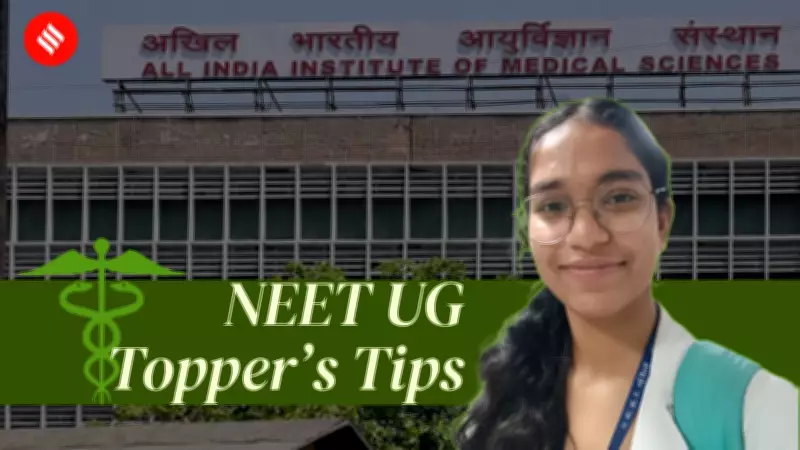
NEET UG Topper Reveals Key Strategies for AIIMS Delhi Success
Vaishnavi Rathod, an 18-year-old from Yavatmal, Maharashtra, has secured admission to AIIMS New Delhi for MBBS after scoring 700 marks in the NEET UG exam on her first attempt. Her journey highlights the importance of structured preparation, health awareness, and resilience in one of India's most competitive entrance tests, with over 20 lakh candidates vying for limited MBBS seats annually.
Core Preparation Principles: Practice, Analysis, and Health
Vaishnavi emphasizes three non-negotiable elements in her NEET UG preparation:
- Extensive Question Practice: "Practice as many questions as possible," she advises, noting that this builds familiarity with exam patterns and concepts.
- Error Analysis with a 'Mistake-Book': She maintained a dedicated notebook to record and analyze errors, helping her avoid repetition and strengthen weak areas.
- Health Prioritization: Often overlooked, health is critical. "Do not ignore your health. Sleep adequately. Take care of hygiene, food, and sleep habits," she stresses, warning against burnout.
Early Motivation and Academic Background
Vaishnavi's decision to pursue medicine was driven by her father's dream and a growing interest in biology after opting for PCMB in school. She studied at Jai Hind College in Chandrapur, scoring 94% in Class 10 and 92% in Class 12. While she considered engineering entrances like JEE and MHT-CET as backups, NEET remained her primary goal, reducing pressure through alternative plans.

Structured Daily Routine and Consistency
Beginning NEET coaching in Class 11, her daily schedule involved morning revisions, long coaching hours, evening question-solving, and night analysis of problems. She admits productivity varied, with self-study ranging from two to six hours daily and longer sessions on weekends. "Consistency is the key," she says, focusing on topics covered and questions solved rather than strict hour counts.
Targeted Revision Strategy
As the exam approached, Vaishnavi tailored her revision:
- Biology and Inorganic Chemistry: Relied heavily on NCERT, revising multiple times and focusing on underlined portions.
- Physical Chemistry: Used notes primarily, with NCERT for theoretical sections.
- Organic Chemistry: Combined notes and NCERT.
- Physics: Depended largely on notes, referring to NCERT as needed.
Mock tests guided her revision, with analysis of weak areas to focus on specific topics.
Overcoming Challenges and Managing Stress
Memorization-heavy sections in biology and inorganic chemistry posed difficulties, overcome by repeated reading and increased question practice. During mocks, she adopted a time-management strategy: skipping time-consuming questions for review later, which helped in the final exam. Vaishnavi acknowledges mental health struggles, saying, "There were days when I used to cry." Coping mechanisms included talking to her mother, journaling, and watching videos, with encouragement to seek professional help if needed.
Future Plans and College Selection
With an All India Rank of 230, Vaishnavi is now pursuing MBBS at AIIMS New Delhi, set to graduate in 2028. She plans to pursue post-graduation and explore specializations. When selecting colleges, she prioritized academics, campus facilities, research exposure, and proximity to home, ultimately choosing AIIMS Delhi for its academic excellence despite the distance.
As NEET UG 2026 approaches in May, her insights offer valuable guidance for aspirants navigating the demanding preparation cycle, emphasizing that success hinges on smart strategies, health maintenance, and emotional resilience.