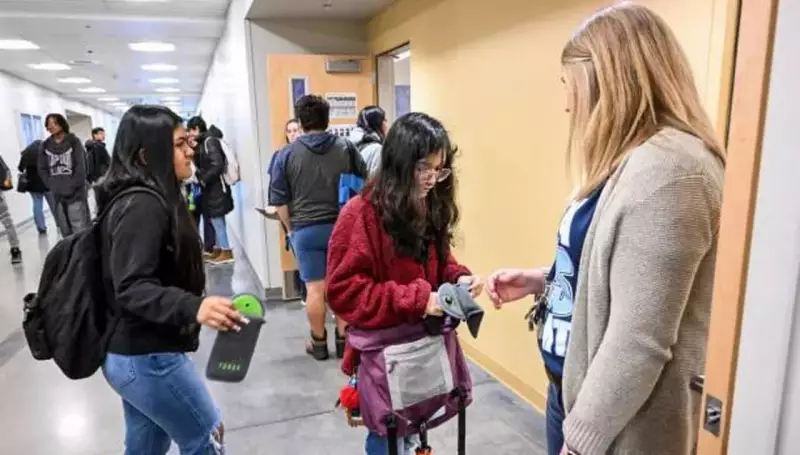
New York City's recent ban on smartphones in its schools has yielded some positive initial results, including quieter hallways and more focused classrooms. However, the policy has also inadvertently highlighted a surprising deficiency among students: a widespread struggle to read traditional analogue clocks.
The Unintended Consequence of a Digital Detox
While educators report that the absence of phones has led to better student interaction and punctuality, it has also exposed significant gaps in fundamental skills. Teachers across the city have observed that many students, suddenly deprived of the digital displays on their devices, are unable to tell time from the analogue clocks mounted on classroom walls.
Tiana Millen, the assistant principal at Cardozo High School in Queens, confirmed the overall benefits of the ban, noting improved socialisation and timeliness. Yet, in comments reported by Gothamist, she revealed a ironic twist: many students are on time "because they don't know how to read the clocks" and thus rely on peers or teachers to know when to move.

Classroom Frustrations and Forgotten Curriculum
The issue persists despite time-telling being a standard part of the curriculum for early primary grades. The New York City Department of Education states that students are taught to read both analogue and digital clocks in first and second grade, with early lessons covering terms like "o'clock," "half-past," and "quarter-to."
English teacher Madi Mornhinweg, who works at a Manhattan high school, told Gothamist that her lessons are frequently interrupted by students asking for the time. Her frustration led her to turn the questions back on them, asking students to identify the big hand and the little hand on the classroom clock.
A Wider Digital Shift and Teacher Interventions
This literacy gap is not entirely new and reflects a broader digital shift. A 2017 study in Oklahoma found only one in five children aged six to twelve could read an analogue clock. Experts like Kris Perry, executive director of Children and Screens, note that teens raised in digital environments have had little practical reason to practice analogue skills.
Some proactive teachers are integrating time-telling into other subjects. Travis Malekpour, a teacher at Cardozo High School, has incorporated telling time and calendar management into his algebra lessons. Students themselves acknowledge the issue. Cheyenne Francis, 14, from Midwood High School in Brooklyn, said she can read a clock but believes classmates forgot because they relied on phones, a point compounded when school clocks are incorrectly set.
While this analogue skill fades, educators also recognise students' strong digital competencies. Mornhinweg shared an instance where her students patiently guided her through new classroom software, showcasing the flip side of their technological fluency.
The smartphone ban, therefore, has become an unexpected litmus test, revealing both the benefits of reduced screen time in schools and the unintended consequences of our digital age on basic, traditional life skills.