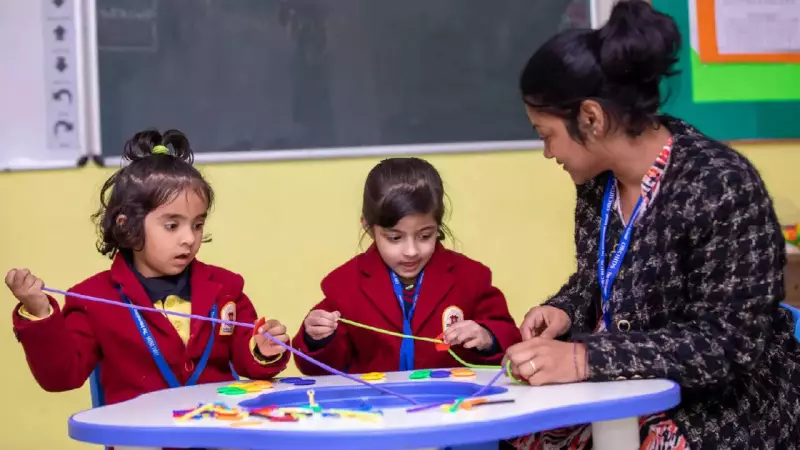
In today's rapidly evolving digital landscape, education has transcended the traditional confines of textbooks and rote memorisation. Indian parents, deeply invested in securing the best future for their children, are grappling with the challenges of raising them in a world that grows faster and more digitally saturated by the day. While screens are an undeniable part of modern childhood, families are thoughtfully navigating their use, striving to balance opportunity with safety.
This careful approach often leads to quick answers, meticulously planned routines, and a concerted effort to minimise risks both online and offline. However, child development specialists warn that this well-intentioned vigilance, if excessive, can backfire. Over-protection can inadvertently erode essential life skills like resilience, curiosity, flexibility, and the willingness to take calculated risks.
The Critical Role of Curiosity in the Information Age
Curiosity is no longer just a desirable trait; it has become a vital survival skill. In an era of information overload where reliability is often questionable, children must learn to interrogate ideas, explore concepts, and construct their own understanding, not just passively accept the quickest answer available.

Research substantiates that children who are encouraged to question and investigate become more engaged learners and adept problem-solvers. Educational institutions can champion this by embracing inquiry-based learning, open-ended projects, and discussions that treat uncertainty as a productive starting point rather than a shortcoming. When schools reinforce a culture of curiosity, it empowers parents to embrace more exploratory, trial-and-error learning at home.
Progressive schools are actively working to restore this essential balance. For instance, Orchids The International School designs its learning environment to reward thoughtful questioning over the speed of a response.
Building Resilience Through Age-Appropriate Risk
Contemporary parenting and education are increasingly moulded by caution, fuelled by safety concerns, academic competition, and digital anxieties. This environment risks producing a generation lacking the confidence to test boundaries or bounce back from failure. Yet, studies consistently highlight that age-appropriate risk-taking is fundamental to developing resilience, curiosity, and problem-solving abilities.
Whether it's attempting an unfamiliar task, voicing an opinion in class, or persevering through a setback, these experiences teach children to adapt and persevere rather than withdraw. By weaving exploration into academics, sports, and co-curricular programmes, schools like Orchids The International School help students build the confidence and cognitive flexibility required to navigate real-world and digital uncertainties.
Shruti Maheshwari, Primary Head at Orchids The International School, commented on this paradigm shift. She stated, "New-age schools are actively shaping not just academically proficient students, but curious and resilient individuals. By fostering inquiry-based learning, we encourage children to ask questions, explore multiple perspectives, and develop a genuine love for learning."
She further added, "Alongside academics, Orchids places a strong emphasis on emotional intelligence, collaboration, and problem-solving skills that equip children to handle real-life situations confidently. Through close collaboration with parents, we promote a balanced guidance approach—supporting children without curtailing their independence. This holistic environment empowers students to adapt, persevere, and thrive in an ever-evolving world."
How Schools Are Shaping Modern Parenting Philosophies
Schools are increasingly becoming reference points for parents facing digital-age dilemmas. Through their classroom methodologies, communication strategies, and community initiatives, schools can model healthier educational approaches. These models prioritise effort over mere outcomes, reflection over unattainable perfection, and growth over the fear of failure.

When educational values consistently emphasise these principles, they gradually help shift parental expectations. The core message becomes clear: preparing children for the future is not about eliminating all risks, but about equipping them with the judgment to manage risks thoughtfully. This partnership is becoming even more crucial in the age of Artificial Intelligence (AI), as students increasingly interact with generative AI tools for their schoolwork.
As childhood continues to transform alongside technology, the synergy between schools and families will be paramount. The ultimate educational outcome may well be raising children who are curious, resilient, and adaptable. Children require the space to question, experiment, and sometimes fail. When schools and parents collectively value curiosity and resilience over mere certainty, they empower children to navigate both technology and life with purpose, adaptability, and sound judgment.
To learn more about the academic philosophy, branches, and admission process, you can visit Orchids The International School.