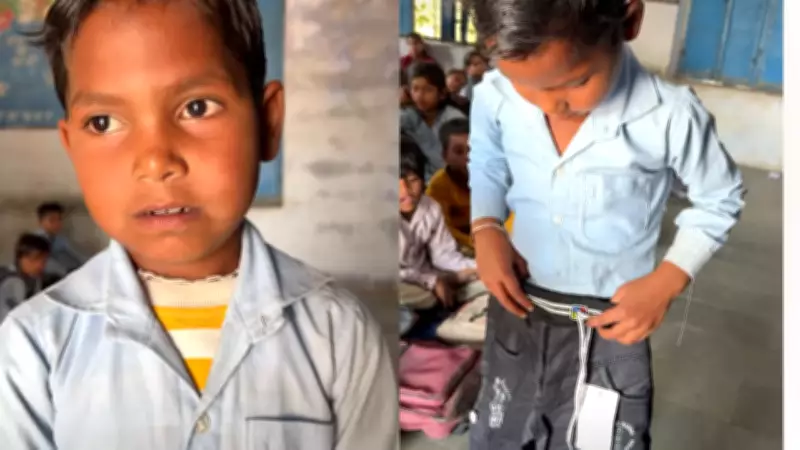
Teacher's Simple Gesture Reveals Deeper Struggles in Government School
A seemingly ordinary classroom interaction in a government school has evolved into a poignant narrative capturing widespread attention across digital platforms. The incident began when a teacher, identified as Shubham Sherwal, observed a minor detail that many might overlook: one of his students was not wearing the complete school uniform.
The Quiet Revelation Behind a Torn Uniform
Initially, the absence of full attire might not have appeared significant, but upon gentle inquiry, the teacher uncovered a story of resilience and hardship. The student, named Raj, explained that his uniform pants were torn. When asked why he had not replaced them, Raj responded with a matter-of-fact tone, stating he would purchase a new pair once his grandfather's pension payment arrived. He further shared that his parents had passed away, and he resided with his grandparents.
This response illuminated a harsh reality silently endured by numerous children, where even fundamental necessities hinge on uncertain financial timelines. Notably, Raj's voice carried no complaint or urgency, merely an acceptance of his circumstances.

From Observation to Action: A Teacher's Decisive Move
Rather than dismissing the moment or turning it into a classroom discussion, Teacher Shubham Sherwal chose to take immediate action. Shortly after the conversation, he personally bought a new uniform for Raj. This act of kindness transcended the mere provision of clothing; it symbolized relief from waiting, the burden of explanations, and the discomfort of feeling different among peers.
The story has since proliferated on social media, with many users describing it as touching and authentic. What resonates profoundly is not solely the charitable deed but the manner in which it unfolded—devoid of drama or buildup, stemming purely from a teacher's attentiveness and subsequent initiative.
Beyond the Uniform: The Broader Impact
For Raj, this gesture meant more than acquiring proper school attire; it represented immediate support and dignity. For observers, it serves as a powerful reminder of the multifaceted role educators play beyond academic instruction. Teachers often detect subtleties that others miss, acting as crucial pillars in students' lives.
There is no grandiose conclusion or extended narrative to this episode. The teacher assisted, the student received aid, and daily routines resumed. Yet, the moment endures, perhaps due to its relatability or its demonstration of how a single, timely decision can create substantial impact.
In an ordinary classroom setting, this quiet act has now reverberated far beyond its origins, inspiring reflections on compassion and responsibility in educational environments.