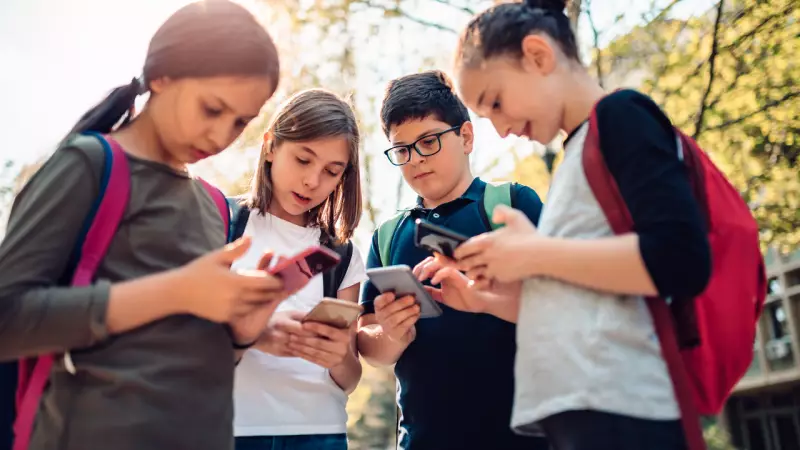
For many American students, a smartphone has become as essential as a notebook in their school bag. While parents often provide these devices for safety, a new study reveals an alarming trend: teenagers are using their phones extensively during school hours, far more than many adults realize.
Objective Data Reveals True Screen Time
The research, published in the prestigious journal JAMA (Journal of the American Medical Association), provides a rare, objective look at phone usage. Instead of relying on self-reported surveys, scientists installed monitoring software on the Android phones of 640 adolescents aged 13 to 18. This passive tracking collected data from September 2022 to May 2024 with full consent from both the teens and their parents.
The findings were striking. On average, adolescents spent 1.16 hours (approximately 70 minutes) of each school day actively using their smartphones. "This moves the conversation beyond anecdotes and self-reports to real-world behavior," explained lead author Dr. Jason Nagata, an associate professor of pediatrics at the University of California, San Francisco. "Teens are not always accurate reporters of their own screen time. Objective smartphone data gives us a clearer picture of actual use."

Social Media Dominates School Hour Usage
So, what are students doing on their phones during class? The data shows a clear preference for social media platforms. Apps like Instagram, TikTok, and Snapchat accounted for the majority of use, followed by YouTube and various games. The study also noted patterns in usage: older teens (aged 16-18) and those from lower-income households tended to have higher levels of smartphone use compared to their peers.
Experts are deeply concerned about the impact of this constant digital distraction. "These apps are designed to be addictive," said the study's senior author, Dr. Dimitri Christakis, a professor of pediatrics at the University of Washington School of Medicine. "They deprive students of the opportunity to be fully engaged in class and to hone their social skills with classmates and teachers." Dr. Christakis practices at Seattle Children's Hospital and emphasized the long-term educational cost.
School Phone Policies: A Work in Progress
In response to such concerns, legislative action is growing. At least 32 states and the District of Columbia now have laws or regulations requiring school districts to ban or restrict student cellphone use. However, the effectiveness of these policies is still unclear. "The effect of those policies 'remains to be seen,'" Dr. Christakis noted, adding, "To date, they've been very poorly enforced, if at all. I think the U.S. has to recognize the generational implications of depriving children of opportunities to learn in school."
This new research builds upon earlier findings published in JAMA Pediatrics and provides a larger, more detailed dataset. For educators, parents, and policymakers in India and worldwide, the study serves as a crucial evidence-based warning. It highlights the significant challenge of balancing connectivity and safety with the fundamental need for undivided attention in the classroom, a debate increasingly relevant in Indian schools as well.