Vadodara's Municipal School Building Rivals Premium Private Institutions Through Innovative Design
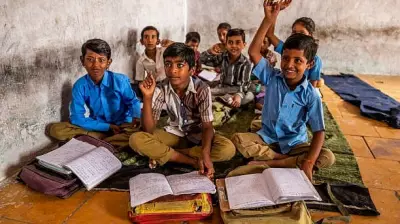
In the heart of Vadodara, a municipal school building has emerged as a remarkable educational facility that proudly stands comparison with numerous private schools. The Shyama Prasad Mukherjee Primary and Secondary School in Atladara represents a significant achievement in educational infrastructure, where the voices of students and teachers were instrumental in shaping its architecture and features.
Preserving Natural Heritage While Building Educational Excellence
The school campus enjoys a serene setting amidst dense green cover, with trees some nearly a century old that appear to have grown organically around the structure. Remarkably, the new building replaced the old facility without disturbing the natural environment that provides the campus with its distinctive calm and charm. Principal Gaurangi Upadhyay confirmed that approximately one hundred trees graced the campus, with only two requiring transplantation due to foundation conflicts.
Participatory Design Process Empowers Educational Community
Before construction began, designers from Round Table India conducted comprehensive workshops involving students and teachers to gather input about their ideal learning environment. "A workshop was held before designing the school, where students and teachers participated. They gave their opinions on what the school should include," explained Principal Upadhyay. The innovative approach divided participants into three student groups engaged in hands-on activities.

Students expressed their visions through multiple creative channels:
- Detailed drawings and paintings depicting their ideal school environment
- Thoughtful essays articulating educational needs and preferences
- Oral presentations and speeches about desired facilities
- Interactive placement of markers on site plans to visualize spatial arrangements
Architectural Innovations Born from Student Insights
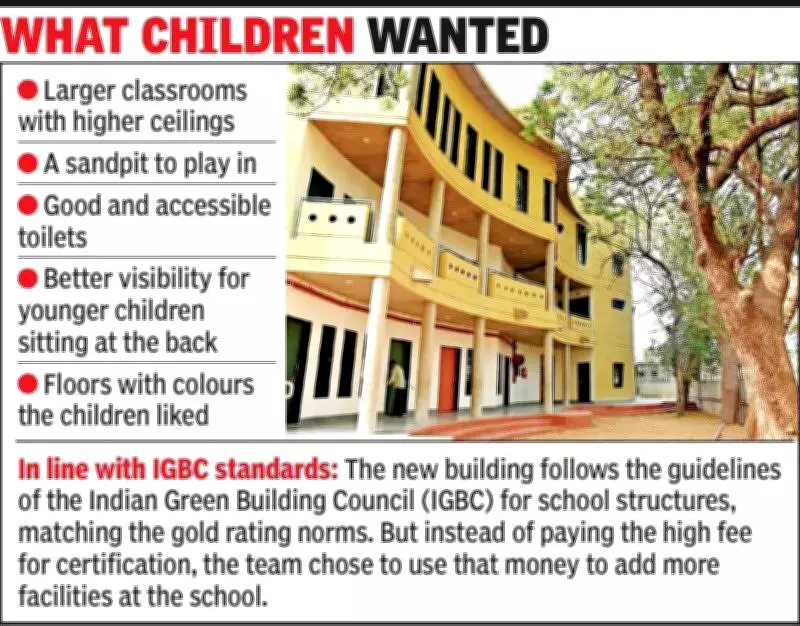
Project architect Bhavik Thakkar emphasized that the design followed a genuinely participatory process. "We incorporated several aspects from the suggestions received at the workshop. These included higher ceilings, larger classrooms, good toilets, a sandpit and others," Thakkar stated. The children had expressed discomfort in low-ceilinged, cramped classrooms, prompting the implementation of ceiling heights ranging from 15 to 18 feet and spacious classrooms measuring 550 to 650 square feet.
Specific student concerns received particular attention. Students from Classes 3 and 4 reported difficulty seeing teachers from their desks, leading to the creation of an innovative amphitheatre-style classroom with stepped seating arrangements. Even flooring materials received student input, with natural stone selected in colors based on children's preferences.
Sustainable Design and Comprehensive Facilities
The architectural design prioritizes natural light and ventilation, incorporating a central atrium with vents that facilitate hot air escape while maintaining consistent fresh airflow throughout the building. The Baroda Young Turks Round Table 201 oversaw the project execution, resulting in a facility now named New Horizon that includes:
- Seven well-designed classrooms with optimal dimensions
- A dedicated activity room for creative pursuits
- A fully-equipped science laboratory
- An extensive library space
- An innovative amphitheatre for presentations and gatherings
The school walls now display fifty paintings created by children during the design workshops, adding personal touches and vibrant colors to the learning environment.
Broader Implications for Municipal Education Infrastructure
VMC primary education committee administrator Vipul Bhartiya noted that eight new school buildings have opened recently, with plans for additional technologically-equipped facilities developed in collaboration with various NGOs. This project demonstrates how municipal schools can achieve excellence through community engagement and thoughtful design, potentially serving as a model for educational infrastructure development across India.

The Shyama Prasad Mukherjee School stands as testament to what becomes possible when educational institutions genuinely listen to their primary stakeholders—the students and teachers who inhabit these spaces daily. The successful preservation of mature trees alongside modern educational facilities creates a unique learning environment that honors both natural heritage and educational innovation.