Andhra Pradesh has firmly established itself as India's leading exporter of students for overseas higher education, consistently topping the charts across multiple years, according to a significant government report. The state's outbound student numbers have shown remarkable resilience and growth, despite global disruptions like the pandemic.
A Consistent Leader in Outbound Student Mobility
The NITI Aayog report, titled ‘Internationalisation of Higher Education in India: Prospects, Potential, and Policy Recommendations', provides a clear state-wise breakdown. Andhra Pradesh sent 46,818 students abroad in 2016, a number that surged to 62,771 by 2018, securing the top position nationally. While the figure dipped to 35,614 in 2020 due to Covid-19 related travel and visa restrictions, the state's lead remained unchallenged.
Over the three reference years (2016, 2018, 2020), Andhra Pradesh's cumulative strength was formidable, well ahead of other major contributors. Maharashtra, which held second place in 2016 and third in the subsequent years, recorded a total of 1.33 lakh students. Punjab, climbing to the second spot in 2018 and 2020, followed closely with 1.3 lakh students. Gujarat demonstrated steady progress, moving from sixth position in 2016 to fourth in both 2018 and 2020, while Tamil Nadu and Delhi remained significant sources.

Shifting Trends and Preferred Destinations
The analysis reveals a strong preference for STEM (Science, Technology, Engineering, and Mathematics) fields among students from Andhra Pradesh. Engineering programmes alone attracted 16.4% of students, while mathematics and computer sciences drew 15.7%. Together, these domains accounted for over one-third of all outbound scholars. Business management was another popular choice, with 12.6% opting for it.
The United States, Canada, Australia, and the United Kingdom emerged as the most sought-after destinations for higher education. However, industry experts note a recent shift. "With tighter immigration and visa regulations in countries such as the United States, several European nations are emerging as alternative study destinations for Indian students," observed Rajesh Masapu, branch manager of Ivy Overseas in Visakhapatnam.
The Ripple Effect and Evolving Patterns
Professor N Venkata Rao, a noted education expert and former vice-chancellor of Dr BR Ambedkar University, linked the trend to the explosive growth of engineering colleges in the erstwhile combined Andhra Pradesh. "The number expanded rapidly from about 40 colleges in 1996 to around 240 by 2004-05, and further increased to nearly 650 between 2005 and 2010," he explained. This created a large pool of graduates seeking advanced studies, often overseas. "Once a batch of students succeeds in their education and careers abroad, it creates a ripple effect," Prof. Rao added.
Rajesh Masapu highlighted a significant evolution in the trend. While postgraduate studies, especially after engineering, were the traditional path, more students are now opting to go abroad for undergraduate degrees immediately after intermediate (10+2). This shift is expected to accelerate as schools in the state adopt international curricula like the International Baccalaureate (IB) and Cambridge programmes. Furthermore, students from conventional undergraduate streams are now increasingly looking abroad for master's degrees, a path once dominated by engineering graduates.
The rise of joint and twinning programmes through tie-ups between Indian and foreign institutions is also facilitating this mobility, allowing students to spend part of their course overseas.
Inbound Students: A Growing but Modest Presence
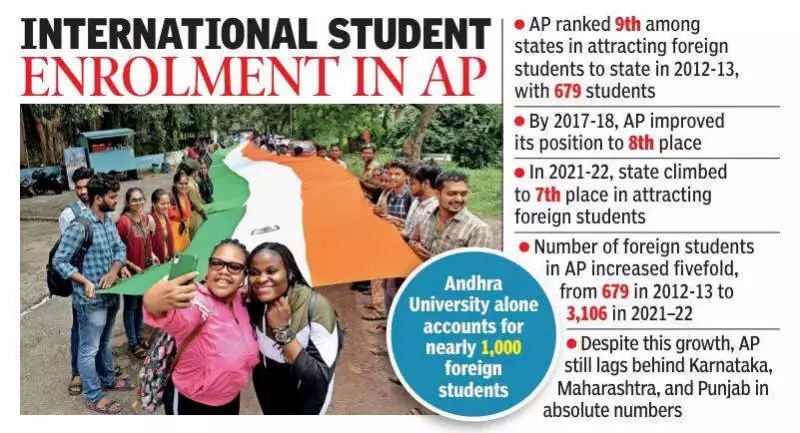
While Andhra Pradesh excels in sending students out, its record in attracting international students, though improving, is more modest. The state ranked 9th in India in 2012-13, hosting only 679 foreign students. Its position improved to 8th in 2017-18 and further to 7th in 2021-22. The number of international students in the state increased nearly fivefold, from 679 in 2012-13 to 3,106 in 2021–22. Andhra University alone accounts for nearly 1,000 of these students. Despite this growth, Andhra Pradesh still lags behind leading states like Karnataka, Maharashtra, and Punjab in absolute numbers.

Looking ahead, unofficial estimates suggest a potential 10-15% decline in students going abroad from Andhra Pradesh over the past year, attributed to stricter global visa norms. Nevertheless, the state's deep-rooted culture of pursuing global education, coupled with evolving academic pathways, ensures it will remain a key player in India's international education landscape for the foreseeable future.