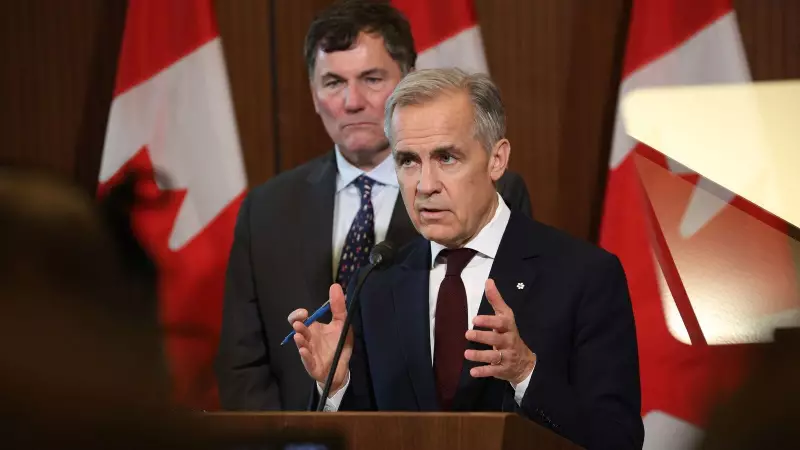
The Canadian government has announced a comprehensive new strategy to attract top international talent, including special provisions for H-1B visa holders and a significant increase in permanent residency targets. Prime Minister Mark Carney revealed the ambitious plan as part of the nation's budget announcement on Wednesday, signaling a major shift in Canada's immigration policy.
Canada's Ambitious Immigration Targets
Under the new initiative, Canada aims to welcome 380,000 permanent residents each year from 2026 through 2028. This represents a substantial commitment to skilled immigration at a time when global talent competition is intensifying. The government plans to invest $1.7 billion specifically for recruiting over 1,000 skilled researchers from around the world.
The budget document explicitly states that "the expertise of these researchers will help advance our global competitiveness and contribute to the economy of the future." This strategic move positions Canada as an attractive destination for high-skilled professionals seeking stable immigration pathways.

Special Focus on H-1B Visa Holders
One of the most significant aspects of Canada's new plan is the creation of an "accelerated pathway" for skilled foreign workers currently on H-1B visas. This initiative comes as a direct response to recent changes in United States immigration policy, where President Donald Trump's administration raised H-1B fees to $100,000, creating uncertainty for many foreign professionals.
The accelerated pathway could provide a welcome alternative for Indian professionals who have been disproportionately affected by the US fee increases. Historically, Indian nationals have constituted a substantial portion of H-1B visa recipients in the United States.
Changing Landscape for Indian Students and Professionals
India has traditionally been Canada's top source of international students, but recent data reveals dramatic shifts in this relationship. During the first three months of 2025, India accounted for 382,055 temporary resident applications approved by Canada, representing 45.8% of all approved applications for study permits, work permits, and visitor visas.
However, the situation changed dramatically by August 2025, when Canada rejected nearly three out of every four study permit applications from Indian nationals. According to Immigration, Refugees and Citizenship Canada (IRCC) data, approximately 74% of Indian applications for study permits to Canadian post-secondary institutions were rejected, compared with just 32% in August 2023.
The sharp increase in rejection rates follows a major fraud scandal that emerged in 2023, when authorities uncovered nearly 1,550 study-permit applications linked to fake admission letters, with most originating from India.
Declining Numbers but Continued Interest
The impact of these changes is evident in the application numbers. The quantity of Indian applicants wishing to study in Canada has dropped dramatically—from 20,900 in August 2023 to just 4,515 in August 2025. Despite this significant decline, India still recorded the highest refusal rate of any country with more than 1,000 approved applicants.
IRCC's annual figures show that about 226,000 Indian students held active study permits in Canada in 2024, down from 319,000 in 2023. This represents the steepest year-on-year fall in more than a decade, indicating a major shift in the educational migration pattern between India and Canada.
While Canada is expanding opportunities for skilled professionals through its new immigration plan, it's simultaneously reducing temporary resident numbers. The government plans to cut temporary residents from 673,650 to 385,000 next year, with further reductions to 370,000 in 2027 and 2028—marking a 40% cut from this year's numbers.

This dual approach of welcoming permanent residents while restricting temporary stays creates a complex landscape for Indian professionals considering Canada. The new initiatives specifically targeting H-1B holders and researchers could provide valuable opportunities for highly skilled Indians, even as student pathways become more challenging.