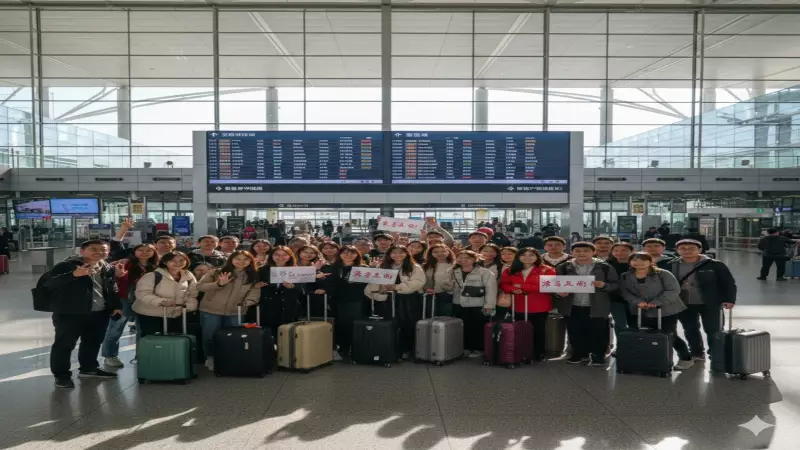
China is witnessing a significant wave of its overseas students returning home, driven by shrinking job and visa opportunities in traditional study destinations like the United States. This mass homecoming is reshaping the domestic employment landscape, creating both opportunities and tensions.
Sharp Rise in Returnees Prompts Government Action
Official data reveals a striking trend: approximately 4.95 lakh (495,000) Chinese students returned to China in 2024 after completing their studies abroad. This marks a substantial 19.1 per cent increase compared to the previous year, according to the Ministry of Education.
Experts like Zheng Jinlian from the Beijing think tank Centre for China and Globalisation predict this number will keep growing. She pointed out that while China's domestic economy faces challenges, it may appear more stable than opportunities elsewhere, especially as countries like the US tighten visa rules for international graduates.

In response to this influx, the Chinese government has launched a national-level service platform designed specifically to help returning students find employment and launch businesses. The Ministry of Education has collaborated with 50 organisations to offer entrepreneurial guidance and directly connect returnees with local government and corporate demands.
Long-Term Impact and National Strategy
The return of overseas talent is not a new phenomenon but has reached a critical mass. Historical data shows that between 1978 and 2024, about 7.43 million Chinese students studied abroad, with 6.44 million eventually returning. These returnees have been instrumental, particularly in driving technological advancement.
The government continues to value this cohort. A recent event in Shanghai celebrating the 30th anniversary of the "Chunhui" programme—a state initiative to encourage overseas scholars to contribute to national development—highlighted this commitment. Authorities have identified key sectors like artificial intelligence and new materials as priority areas for absorbing overseas talent.
Their influence is already profound. China’s Ministry of Human Resources and Social Security stated that as of 2023, over 70 per cent of leaders in key national projects, university presidents, and directors of top-tier hospitals were returnees from overseas studies.
Mounting Tensions in a Competitive Job Market
This homecoming, however, is not without friction. The large-scale return has sparked resentment among local Chinese graduates. Employers often prefer foreign-educated candidates for their perceived superior technical expertise and English language skills, creating an uneven playing field.
The pressure is immense. China's job market must absorb over 12 million new graduates every year, amid reports of an unemployment rate hovering around 19 per cent. The influx of highly skilled returnees intensifies this competition.
Despite some public scepticism about the value of foreign degrees, Zheng Jinlian argues that "overseas students drive innovation and entrepreneurship" and remain vital to talent development. The government's latest measures seem to reinforce this view, aiming to strategically harness this returning talent pool to fuel future growth, even as it navigates the domestic social and economic pressures their return creates.