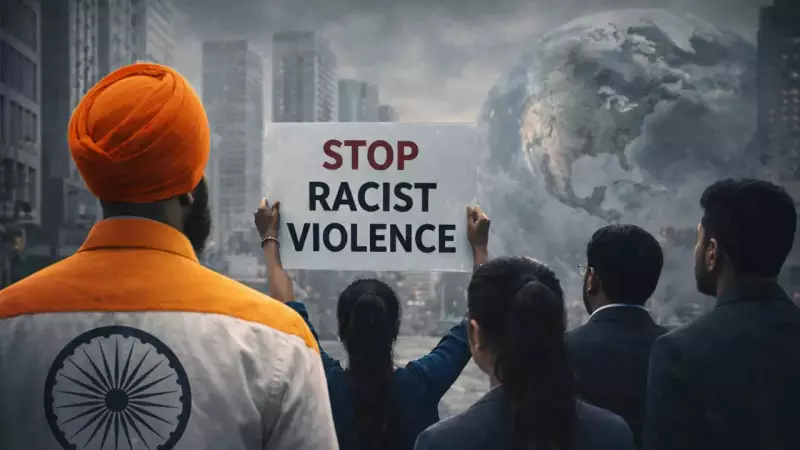
While India prepares to honour its global community on Pravasi Bharatiya Divas, a series of brutal attacks on Indians living overseas casts a long shadow over the celebrations. From a beheading in the United States to assaults on elderly Sikh men in the United Kingdom and attacks on children in Ireland, a pattern of racial hostility and violence is emerging, forcing a difficult question: how safe are Indians beyond their homeland's borders?
A Disturbing Pattern of Violence Across Continents
The incidents are geographically widespread but united by their hateful nature. In Texas, USA, 26-year-old Chandrashekar Pole was shot dead while working at a gas station merely six months after completing his Master's degree. Separately, 50-year-old Chandra Nagamallaiah was attacked and killed by his employee after an argument.
Across the Atlantic, the United Kingdom witnessed the attack of two elderly Sikh men outside a railway station in Wolverhampton, where teenagers forcibly removed their turbans. In a separate tragic event, Vijay Kumar Sheoran, a former Indian government officer and student from Haryana, was stabbed to death on Barbourne Road.

In Ireland, long considered immigrant-friendly, violence has spiked sharply. A group of teenagers assaulted an Indian man, beating and partially stripping him while filming the ordeal. In a separate harrowing incident in County Waterford, a six-year-old Indian girl was punched, hit with a bicycle, and told to "go back to India."
In Canada, the promising life of 20-year-old doctoral student Shivank Avasthi was cut short when he was shot dead near the University of Toronto Scarborough campus. These are not isolated events but part of a sobering global trend.
Data Reveals Broader Risks Beyond Violent Crime
Official data from the Ministry of External Affairs (MEA) provides crucial context. Between 2018 and 2024, 842 Indian students died abroad. Analysis shows that roughly 96% of these deaths were due to medical conditions, suicides, accidents, or other non-violent causes. Only about 4% resulted directly from violent crimes.
This highlights a critical truth: while violent attacks grab headlines, mental health struggles, unsafe working conditions, and lack of support systems pose even greater risks. Financial pressure often forces students into late-night, high-risk jobs, increasing their vulnerability.
However, open-source intelligence (OSINT) data from 2020 to 2024 indicates a worrying rise in targeted physical attacks. Reported incidents jumped from just 3 in 2020 to 40 in 2024. Countries like the UK, US, Canada, Ireland, and Germany have recorded multiple stabbings, assaults, and other violent acts.
Historical Precedents and the Digital Layer of Hate
This vulnerability is not entirely new. In the late 1980s, the Indian community in Jersey City, USA, faced a wave of attacks by a group calling themselves the "Dotbusters." In 1987, Navroze Mody died days after being assaulted. Today, the threat has a digital dimension.
Research by the Centre for the Study of Organized Hate tracked 128 high-engagement posts targeting Indians on platform X in a short period between December 2024 and January 2025. These posts, reaching millions, spread harmful stereotypes labelling Indians as job-stealers or culturally incompatible, reviving colonial-era prejudices about hygiene, food, and accent.
Government Response and the Limits of Jurisdiction
In response to growing concerns, the MEA maintains that the welfare of overseas Indians is a priority. The government states it takes such incidents "very seriously" and raises them with host nations through diplomatic channels. However, it also clarifies that crimes abroad fall under the jurisdiction of the host country.
Indian missions provide crucial consular assistance, including:

- Acting as the first point of contact with local authorities.
- Operating 24x7 helplines in countries with large Indian populations.
- Using the Consular Services Management System (MADAD) for grievance redressal.
- Assisting with documentation and repatriation in tragic cases.
As India marks Pravasi Bharatiya Divas, commemorating Mahatma Gandhi's return from South Africa in 1915, the achievements of the diaspora are undeniable. Yet, the recent incidents are a stark reminder that global mobility brings not just opportunity, but also the need to navigate racism, stereotypes, and hate-fuelled hostility. For millions building lives abroad, the quest is for more than acceptance—it is for the fundamental right to safety and protection.