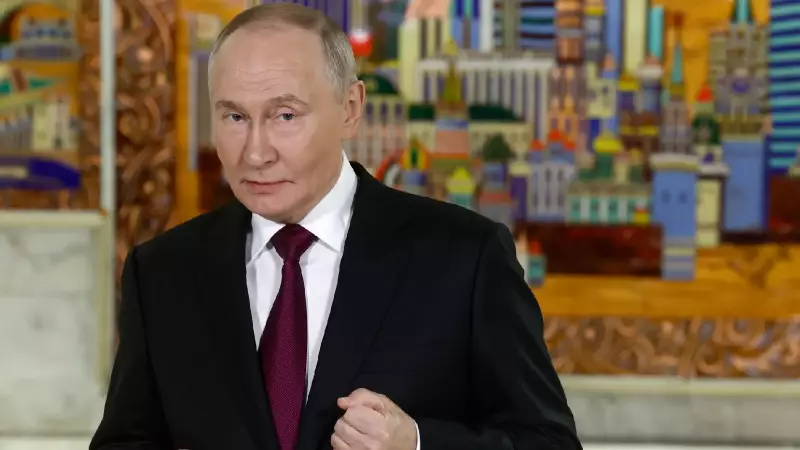
As Russian President Vladimir Putin arrives in India for an official visit, the spotlight inevitably falls on his geopolitical moves. Yet, for many students and observers, a more personal question arises: what shaped the man behind the powerful image? Long before summits and global headlines, Putin's journey unfolded through the classrooms and corridors of Soviet-era Leningrad, where early education, language skills, and martial arts discipline quietly forged the foundations of a future world leader.
The Formative Years: Discipline in Leningrad's Schools
Vladimir Putin's formal education began on 1 September 1960 at School No. 193, a typical neighbourhood institution near his home on Baskov Lane. The environment was characteristic of the Soviet system: crowded classrooms, strict rules, and a focus on structure. Here, the young Putin began to understand systems of authority.
He was not considered a model pupil in his early years. Teachers remembered him as a curious but easily distracted student. In a notable detail, he was one of the few in his class who had not joined the Young Pioneers, the communist youth organisation, making him subtly stand out.

Beyond the standard curriculum, Putin developed a habit of wide reading, particularly in history and political theory. A pivotal moment came at age 12 when he discovered sambo and judo. This training instilled a rigorous routine and a mental discipline that would later influence his approach to academics and his strategic goals.
The Linguistic Leap: German and a Global Outlook
A significant shift occurred when Putin moved to School No. 281 (Saint Petersburg High School 281), renowned for its intensive German language programme. This choice proved to be a cornerstone of his future.
Immersed in daily German lessons, he gained not just language proficiency but also a window into another culture's mindset. This skill became a strategic asset decades later, allowing him to surprise diplomats in fluent German during high-stakes meetings. This period also sharpened his interest in international affairs, steering his conversations toward geopolitics, borders, and diplomacy while peers focused on more commonplace topics.
University and Mentors: The Path to Law and Politics
In 1970, Putin enrolled at Leningrad State University to study law. The degree demanded meticulous attention to detail, extensive reading, and a grasp of international legal frameworks—all competencies that would serve him immensely.
His academic thesis focused on the Most Favored Nation trading principle, revealing an early analytical interest in global economic structures. Perhaps more importantly, university life introduced him to a pivotal mentor: Professor Anatoly Sobchak. Sobchak, who taught business law, formed a student-teacher bond with Putin that evolved into a powerful political alliance. When Sobchak later became Mayor of Saint Petersburg, he brought Putin onto his team, providing the crucial springboard into national politics.
Graduating in 1975, Putin's academic toolkit—languages, legal analysis, and discipline—paved his way into the KGB, where he served for 16 years in foreign intelligence.
Later Academic Pursuits: Energy as a Strategic Tool
Putin returned to academia in 1997 at the Saint Petersburg Mining University. He earned a postgraduate degree in economics, submitting a thesis that analysed how nations leverage energy resources as instruments of foreign policy. This research was prescient, completed before Russia's energy sector became central to its global influence.
Once again, an academic connection proved influential. His thesis supervisor, Vladimir Litvinenko, later played major roles in Putin's political campaigns, underscoring how scholarly networks continued to shape his professional trajectory.

Putin's educational path was neither linear nor predestined. It progressed from an ordinary Soviet classroom to a language-specialised school, through a premier law faculty, and into advanced economic research. Each phase added a critical layer: linguistic ability, physical and mental discipline, influential mentors, and academic interests that dovetailed with national strategy.
For students today, this journey underscores how foundational experiences—the choice of a subject, the influence of a teacher, or the pursuit of a personal passion—can unexpectedly chart the course of a future life, even one that comes to dominate the world stage.