For aspirants of the Union Public Service Commission (UPSC) examinations, connecting daily current affairs to the syllabus is paramount. The events of December 5, 2025, offer a rich tapestry of issues spanning governance, international relations, social policy, and economic strategy, each holding significant relevance for both the Prelims and Mains stages.
IndiGo's Operational Crisis: A Perfect Storm of New Rules and Crew Shortage
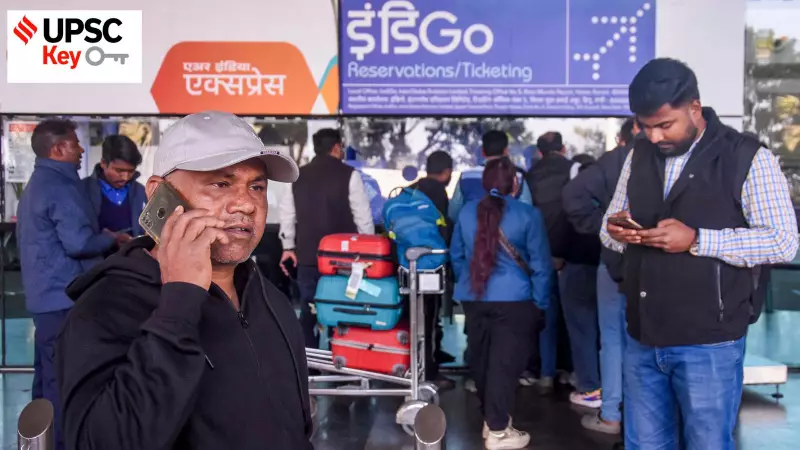
India's aviation sector witnessed significant turbulence as the country's largest airline, IndiGo, was forced to cancel over 400 flights on a single day. The chaos at airports like Ranchi's Birsa Munda International Airport highlighted a severe operational breakdown, primarily attributed to acute crew shortages.
The root cause of this disruption lies in the newly implemented Flight Duty Time Limitation (FDTL) norms by the Directorate General of Civil Aviation (DGCA). These revised rules, rolled out in phases from July 1 and November 1, 2025, are designed to enhance pilot welfare and flight safety. Key changes include increasing the mandatory weekly rest period for pilots to 48 hours from 36, limiting night landings to two (down from six), and capping consecutive night duties.

While applicable to all domestic carriers, IndiGo faced the brunt due to its unique operational model. The airline's high-frequency network, significant number of late-night flights, and lean, high-utilization staffing strategy left it particularly vulnerable to the stricter rostering requirements. With a fleet exceeding 400 aircraft operating over 2,300 daily flights, the new constraints exposed systemic planning issues.
The Federation of Indian Pilots (FIP) criticized the airline's "lean manpower strategy," alleging a hiring freeze and unorthodox practices despite a two-year preparation window. In response, the DGCA mandated IndiGo to submit a detailed mitigation plan and bi-weekly progress reports to stabilize operations. This incident underscores broader challenges in India's civil aviation sector, including infrastructure strain, regulatory implementation, and workforce management, making it a crucial case study for UPSC aspirants.
Modi-Putin Summit: Charting a Strategic Economic Roadmap to 2030
The state visit of Russian President Vladimir Putin to New Delhi marked a significant moment in bilateral diplomacy, being his first since the onset of the Russia-Ukraine war in February 2022. The summit between Prime Minister Narendra Modi and President Putin was poised to unveil a declaration for Strategic Economic Cooperation until 2030.
The talks covered a wide spectrum of cooperation. A major focus was on defence and energy, with discussions on the S-400 air defence systems, the Sukhoi-57 fighter aircraft, and civilian nuclear cooperation, including Russian Small Modular Reactors (SMRs). In the trade arena, both nations aimed to address the lopsided trade balance—which reached a record USD 68.7 billion in FY 2024-25, heavily skewed towards Russian oil imports—by enhancing market access for Indian products like pharmaceuticals and agricultural goods.
The context of the visit was particularly delicate, coinciding with the Trump administration's imposition of penalty tariffs on India over its Russian oil purchases. This scenario tests India's diplomatic dexterity in maintaining its "special and privileged strategic partnership" with Moscow while navigating complex Western alliances. The outcomes of this summit are vital for understanding India's foreign policy doctrine, its energy security calculus, and its position in the evolving global geopolitical order.
Census 2027: Confronting the Data Gap on Caste and Migration
The prolonged delay of India's decadal census has emerged as a critical governance and policy challenge. With the last census conducted in 2011, the exercise due in 2021 was postponed, and the government has now designated the next enumeration as Census 2027. This creates a 16-17 year data gap, the longest since Independence, with far-reaching consequences.

The delay impacts welfare scheme targeting, urban planning, Finance Commission transfers, and crucially, the implementation of the women's reservation law, which is contingent on delimitation based on the first census after 2026. Census 2027, which will be India's first digital census, presents an opportunity to correct historical blind spots.
A pivotal debate surrounds the inclusion of comprehensive caste data. Beyond Scheduled Castes and Tribes, India has not officially enumerated all castes since 1931. The unreleased 2011 Socio-Economic and Caste Census (SECC) data remains a contentious issue. Accurate caste data is essential for evidence-based policy on social justice and OBC reservations.
Equally important is accurately capturing internal migration. Millions of workers are counted in their native villages but live and work in cities, leading to misallocation of resources and a disconnect in urban governance and political representation. Ensuring the digital census is transparent, protected from surveillance, and comprehensive will be foundational for India's democratic and planning machinery for the coming decades.
Beyond E20: The Government's Next Move Towards Flex-Fuel Vehicles
Following the nationwide mandate for E20 fuel (20% ethanol blend) compatibility in new vehicles from 2023, the focus is shifting to the next phase of India's energy transition. Industry leaders, like Toyota Kirloskar Motor's Vikram Gulati, advocate for a policy push towards Flex-Fuel Vehicles (FFVs) that can run on any blend of petrol and ethanol, up to 100% (E100).
The argument for FFVs over incrementally increasing the blend to E25 or E30 is twofold. First, it avoids the need for repeated retesting and re-homologation of legacy vehicles with each blend change. Second, it provides consumers with fuel choice, especially if pure ethanol is priced cheaper than petrol, as seen in successful markets like Brazil.
The move aligns with the National Policy on Biofuels 2018 and aims to reduce India's massive crude oil import bill, enhance energy security, and lower carbon emissions. However, challenges remain, including the higher upfront cost of FFVs, establishing a widespread ethanol distribution network, and ensuring stable pricing to incentivize cleaner fuel use. This policy direction is key to understanding India's approach to sustainable mobility and industrial strategy.
Other crucial updates for aspirants include a study by ISRO's Space Applications Centre noting a shift in the timing of stubble-burning peaks in Punjab and Haryana, Finance Minister Nirmala Sitharaman's clarification on the proposed Health and National Security Cess, and concerning data showing a rise in road accident fatalities in 2024, moving India away from its 2030 safety target.