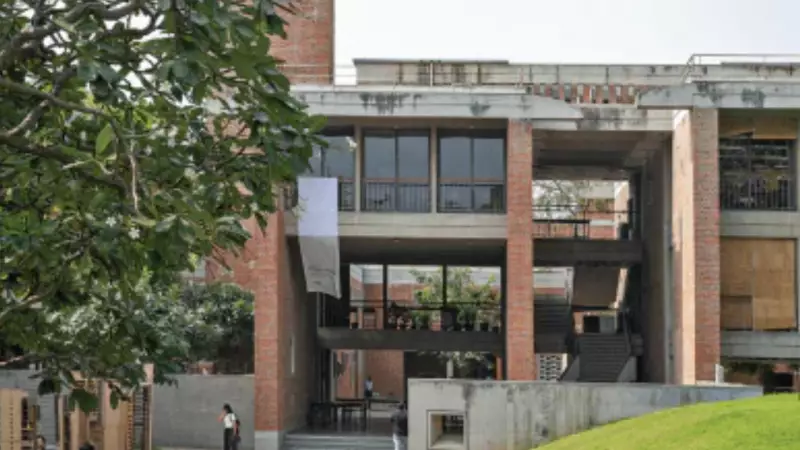
In a significant step for India's construction technology landscape, CEPT University in Ahmedabad has forged a strategic alliance with Chennai-based deep-tech startup Tvasta Manufacturing Solutions Pvt. Ltd. The collaboration, formalized through a Memorandum of Understanding (MoU), is set to establish an advanced additive manufacturing workshop on the CEPT campus, positioning the university as a leading academic center for automated concrete construction in the country.
A Fusion of Academic Excellence and Technological Prowess
This partnership strategically merges CEPT's established academic leadership in architecture and the built environment with Tvasta's pioneering expertise in robotic 3D concrete printing. The result is a powerful national platform designed to integrate research, education, and hands-on prototyping under one roof. The initiative is co-led by Prof Jinal Shah, Program Chair of the Masters in Computational Design and Fabrication (MCDF) at CEPT, and Mr Kalyan Vaidyanathan, Chief Technical Officer – Construction at Tvasta.
Under the terms of the agreement, Tvasta will install a state-of-the-art robotic arm at CEPT capable of printing complex concrete geometries. This specialized technology is currently available at only a select few Indian institutions. The workshop, slated to become operational in the coming months, will serve as the core of a multidisciplinary collaboration spanning design studios, funded research projects, and practical construction challenges.

Research Aims and Future Applications
The collaboration has outlined an ambitious research agenda focused on pushing the boundaries of 3D printing in construction. Key areas of exploration will include:
- Printed façade elements and integrated structural systems where walls, slabs, and roofs are created as a single, continuous unit.
- Innovative construction methods, such as embedding electrical conduits directly into printed walls.
- Investigating how 3D-printed concrete can be optimized for climate responsiveness, heat management, and airflow.
- Developing printed components for off-site fabrication and assembly in locations where traditional building methods are impractical or impossible.
Prof. Chirayu Bhatt, Deputy Provost (Academics) at CEPT University, emphasized the importance of the move, stating, "Technological innovation is central to our University’s vision for the future of the built environment. This agreement will enable students and faculty to prototype, experiment and rethink the way India conceives and constructs its buildings."
Bridging the Gap Between Academia and Industry
From an academic standpoint, Prof. Jinal Shah highlighted the transformative potential, noting 3D concrete printing's role in mass customization, material efficiency, and sustainability. "The collaboration with Tvasta will strengthen research, design development and rapid prototyping through an integrated design and construction approach," she said.
For Tvasta, the partnership solidifies a crucial link between foundational research and real-world application. "We are excited to collaborate with CEPT University, a world-renowned institution," said Mr. Kalyan Vaidyanathan. He revealed plans for joint studio courses in Design for Additive Manufacturing (DFAM), where student projects will be physically realized using Tvasta's printers, alongside collaborative R&D in energy-efficient construction.
The partnership builds on existing engagement, with CEPT's MCDF and Bachelor of Architecture students having already visited Tvasta's facilities in Chennai and Bhiwandi. The on-campus workshop is expected to transform these introductory visits into in-depth studio projects, demonstrations, and long-term research initiatives, equipping students with future-ready skills at the intersection of material science, structural engineering, and digital fabrication.