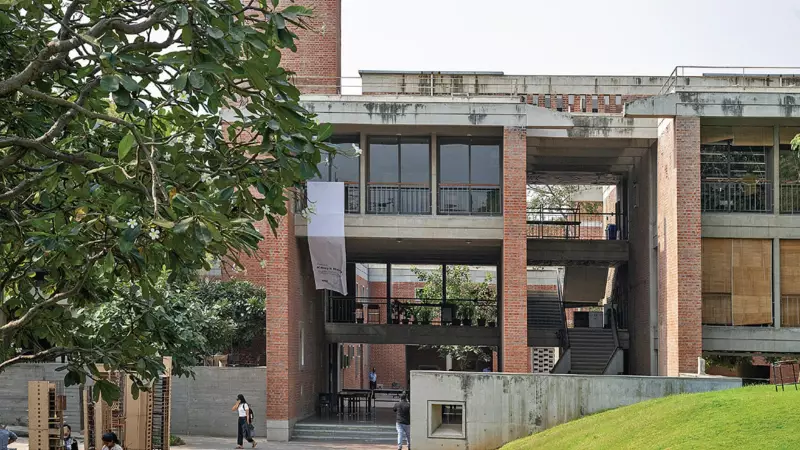
In a significant move to advance construction technology education and research, CEPT University in Ahmedabad has forged a strategic partnership with Chennai-based deep-tech startup Tvasta Manufacturing Solutions. The collaboration, formalized through a Memorandum of Understanding (MoU) signed on Monday, December 2, 2025, will establish a state-of-the-art additive manufacturing and 3D concrete printing workshop on the university campus.
A Hub for Advanced Construction Research
As per the agreement, Tvasta Manufacturing Solutions will provide a specialized robotic arm capable of printing intricate and complex concrete forms. This installation will position CEPT University among a select group of premier institutions in India equipped with such cutting-edge research infrastructure. The workshop is slated to be developed over the coming months and is designed to be a multidisciplinary resource.
It will actively support teaching studios, applied research projects, and the development of prototypes aimed at solving real-world construction challenges. The initiative is spearheaded by Prof Jinal Shah, Programme Chair of the Masters in Computational Design and Fabrication (MCDF) at CEPT, and Kalyan Vaidyanathan, Chief Technology Officer (Construction) at Tvasta.

Expanding the Frontiers of 3D-Printed Construction
The core objective of this partnership is to substantially broaden the scope and application of 3D-printed concrete. Joint research will delve into innovative areas such as printed façades, integrated structural systems, embedding electrical conduits directly into prints, and creating environmentally responsive architectural forms.
A key focus will also be on developing pre-fabricated components that can be printed off-site and assembled in remote or challenging terrains, where traditional construction methods are impractical or impossible. This has profound implications for infrastructure development in difficult landscapes.
Empowering the Next Generation of Builders
The integration of advanced additive manufacturing into CEPT's academic ecosystem is poised to transform student learning. Deputy Provost Prof Chirayu Bhatt emphasized that this facility will empower students to "prototype, experiment and rethink how India conceives and constructs its buildings."
Prof Jinal Shah added that the collaboration strengthens the university's focus on rapid prototyping, material-driven design, and sustainable construction approaches. Furthermore, Tvasta, a pioneer of 3D-printed structures in India, will co-offer DFAM (Design for Additive Manufacturing) studio courses. In these courses, students will have the unique opportunity to translate their digital designs into physical structures using robotic printing systems.
Creating a National Platform for Innovation
The new on-campus setup is expected to deepen hands-on research, experimentation, and innovation. Students have already gained preliminary exposure to similar facilities operated by Tvasta in Chennai and Bhiwandi. This partnership effectively bridges CEPT's academic leadership in the built environment with Tvasta's trailblazing expertise in automated concrete construction.
Together, they aim to create a national-level platform dedicated to research, teaching, and innovation in next-generation construction technologies. This initiative marks a concrete step towards modernizing India's construction sector through education and technological adoption.