From Personal Tragedy to Lifelong Mission
On a quiet road in Ayodhya, a story of profound loss and remarkable redemption began to unfold. Mohammad Sharif, a bicycle mechanic from the city once known as Faizabad, experienced a devastating personal tragedy in 1992 when he lost his eldest son, Raees Khan, under brutal circumstances. The body was never properly claimed, and by the time Sharif discovered what had happened, the evidence left behind was heartbreakingly minimal: just a shirt and a tailor's note.
Out of this profound grief emerged a solemn vow that would define the rest of his life. Sharif decided that no one should be denied a final farewell simply because they were poor, unknown, or unloved. This personal commitment would evolve into a remarkable humanitarian mission spanning nearly three decades.
A Daily Routine of Uncommon Devotion
What followed was not merely a symbolic gesture but a daily practice of extraordinary dedication. Sharif began systematically checking police stations, hospitals, railway stations, and mortuaries for bodies that no one came to claim. If 72 hours passed without any family stepping forward, he would personally arrange the last rites according to the deceased person's faith.

Over the years, he transported bodies using whatever means available—sometimes on his bicycle, other times on a pushcart. He worked with local helpers and relied on donations when funds ran short. In a 2020 profile, Sharif described this work as deeply personal, emphasizing that he never thought in communal terms. For him, every deceased person was simply human, deserving of dignity in their final moments.
The Universal Resonance of a Simple Life
Sharif's work resonated widely precisely because of its intimate yet universal nature. He was neither a public official nor a wealthy donor, but rather a working mechanic and father who continued earning a living with his hands while spending his spare hours providing strangers with their final rituals. This contrast between his modest circumstances and his outsized sense of duty is what made his story travel so far.
His family supported him through the grim practicalities—the smells, the blood, and the emotional weight—because they understood he was trying to repair in the world what had been broken in his own life. Sharif carried two lives simultaneously: the daily grind of a bicycle mechanic and the profound burden of a larger calling.
Honoring Every Faith with Equal Respect
Sharif demonstrated particular care regarding something many might have overlooked: religious faith. If the deceased was Hindu, he arranged a cremation with appropriate rituals. If the person was Muslim, he ensured a proper burial. Over time, he became known for performing last rites according to the traditions of the deceased, refusing to let religion become a barrier even in death.
Locals began affectionately calling him Sharif Chacha, recognizing him as a man who quietly crossed religious boundaries while giving strangers the dignity of a proper farewell. His work became a powerful testament to interfaith harmony in practice.
National Recognition for Decades of Service
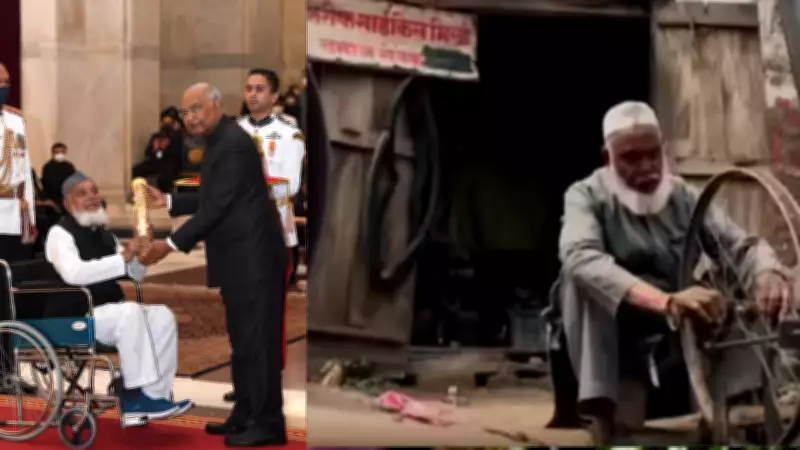
The Government of India announced Mohammad Sharif as a Padma Shri awardee in 2020, formally recognizing his decades of service in providing last rites to unclaimed bodies in Ayodhya. In the official Padma Awards list released that year, his name appears under the Social Work category for Uttar Pradesh.
The list notes that the president approved 141 Padma Awards in total, including 118 Padma Shri honors, placing Sharif's work among the country's most respected civilian contributions. Due to pandemic-related delays, the ceremony was held later, and Sharif received the honor at Rashtrapati Bhavan in November 2021, where the award was presented by the President of India.
The Enduring Legacy of Ordinary Compassion
Sharif's life story is profoundly moving not because it is grand, but because it demonstrates how real compassion often manifests in stubbornly ordinary ways. There are no polished speeches, institutional blueprints, or easy heroics in his narrative—just a man who looked at forgotten deaths and refused to let them remain forgotten.

In a country where rituals carry enormous emotional and social weight, Sharif's insistence on dignity matters profoundly. His work communicates a powerful message: the final chapter of a human life should not depend on whether someone has family, money, or status. At the very least, it should depend on whether another human being is willing to stand in and ensure a dignified farewell.