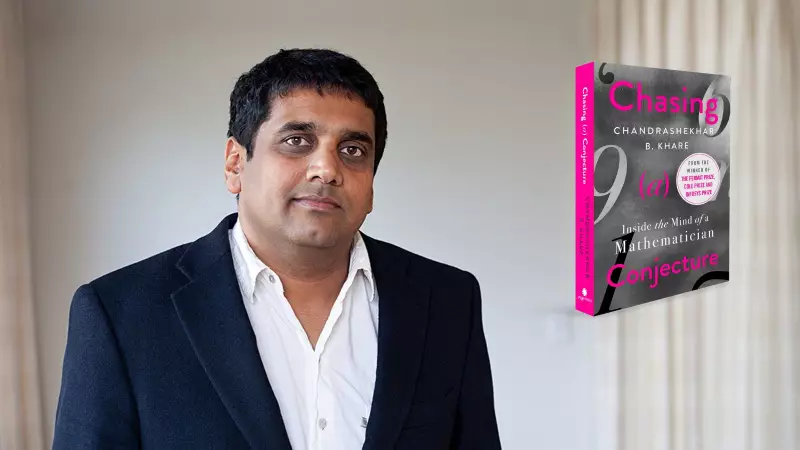
For acclaimed mathematician Chandrashekhar Khare, the decade-long quest to prove a pivotal number theory conjecture was not a cold, abstract calculation. It was a form of "divine madness"—a deeply human, creative, and often addictive pursuit. In his new memoir, Chasing (a) Conjecture, the UCLA mathematics department chair maps this intricate journey of the mind, weaving together threads of Hindustani classical music, Marathi literature, and philosophical introspection.
The Alchemy of Intuition and Rigorous Proof
Speaking from his home at the University of California, Los Angeles, Khare dismantles the stereotype of the lone genius lost in abstraction. He describes mathematical research as a delicate dance between two forces: the sudden flash of creative intuition and the unyielding scaffold of logical rigour. "A conjecture is just an outgrowth of wanting to know an answer without knowing the answer, guessing the answer," he explains. "But on the other hand, it never is on firm ground until you manage to prove it. In mathematics, the gold standard is proof."
He compares the process to a musician's riyaz (practice). Solving profound problems requires saturating the mind in the subject for months or years, hoping for that insightful spark. "It's like catching a scent of something. And then you follow your intuition and follow that with analytical and rigorous logical thinking," Khare says. This pursuit, he admits, is all-consuming and addictive, akin to an oyster creating a pearl from an irritant. "Mathematics is addictive because it is in the mind... It's a very addictive form of thinking."

Expanding the Bullseye: On Failure and Persistence
The path to proving Serre's conjecture, a monumental achievement in number theory, was strewn with failure. Khare candidly recalls his graduate student days at Caltech, a period of such intense struggle that he nearly quit mathematics entirely. "To be able to concentrate on something, you need to be a little bit good at it. If you're getting nothing out of something, it's impossible to keep pursuing it. You have to cross that critical line at which the subject starts rewarding you," he reflects.
His advice to students, particularly in India's high-pressure academic landscape, is to redefine success. "Don't be discouraged by how brilliant other people are... In a creative endeavour, there is scope for a lot of different kinds of being brilliant. The person who's quickest will not necessarily do the best," he states. Khare shares a resonant quote from a Japanese mathematician: "If you cannot hit that bullseye, just expand the bullseye." The essential qualities, he emphasises, are persistence, a deep, sustained interest, and rigour about oneself.
The Person Behind the Proof: A Tapestry of Influences
At the heart of Khare's philosophy is a cherished quote from mathematician Charles Hermite: "It is the person, and not the method, who solves a mathematical problem." This belief underscores why his world view extends far beyond equations. His conversation and memoir are rich with references to the Bhakti saints, Charles Dickens, Virginia Woolf, and the music of Kishori Amonkar and Kumar Gandharva.
"I like to have things where I'm not being told specific things. I like an atmosphere being created and music does that... In mathematics, the results I like the most are where you somehow start with something you don't know quite what you're doing... and create a structure starting with nothing," he says, drawing a parallel between artistic and mathematical creation.
He also dismantles the myth of solitary genius. While deep work requires solitude, modern mathematics is a collaborative global enterprise. "The image of a person sitting in a room and just thinking is not the way mathematics is done currently. You are always using ideas and insights of people doing mathematics all over the world," Khare notes.

Following his success with Serre's conjecture, Khare has embarked on another long quest—this time for the Leopoldt Conjecture. He enters this new "wilderness" without the confidence of a guaranteed solution but with a commitment to the journey itself. "I'm not confident I'll ever solve this conjecture. But then to go in a wilderness, go on a journey, because then your failure kind of sensitises you to certain aspects of mathematics," he reveals.
Today, his drive stems less from the need for another monumental proof and more from the pure joy of the search. "The joy is in the discovery, the collaboration... I do mathematics for the pleasure of it. It is a romantic quest," Khare concludes. Through his memoir, his target is the non-mathematician, aiming to convey that mathematical research is a profoundly creative endeavour, sharing the same struggles and ecstasies as music or art. In Chasing (a) Conjecture, Chandrashekhar Khare renders the abstract palpably human, proving that the most profound proofs are ultimately about the beautiful, maddening persistence of the human spirit.