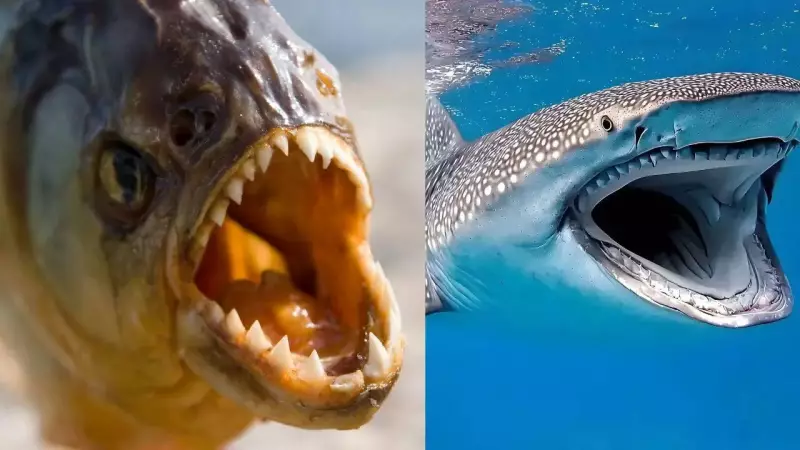
A battle between a shark and a piranha sounds like the plot of a Hollywood thriller, but for scientists, it's a fascinating study in contrasting evolutionary power. One dominates the oceans with immense size, while the other rules freshwater rivers with a ferocity that defies its small stature. Researchers study these two iconic predators not because they meet in the wild, but because they represent two completely different blueprints for predatory success.
Absolute Power vs. Relative Strength: The Bite Force Battle
When it comes to raw, absolute power, the Great White Shark is nearly unmatched. Its bite force can reach a staggering 4,000 pounds per square inch (PSI). This incredible power, combined with sharp, serrated teeth designed for slicing and a high-speed ambush attack, allows it to rip massive chunks of flesh from prey like seals in a single motion. Its size, averaging 18 to 26 feet in length and 2,000 to 5,000 pounds in weight, and speed of up to 35 miles per hour cement its place at the top of the oceanic food chain.
In the freshwater rivers of South America, the Black Piranha operates on a different principle. With a maximum bite force of only about 70 PSI, it seems puny in comparison. However, pound for pound, it delivers one of the most powerful bites in the natural world. This is because its secret lies not in sheer muscle mass, but in extreme leverage.

Anatomy of a Super-Bite: How Piranhas Pack a Punch
The black piranha's astonishing bite strength relative to its 0.5 to 1.2-foot body and 3 to 7-pound weight comes from its unique anatomy. It possesses extremely short, powerful jaws where the muscles account for a large percentage of its total body mass. This design provides tremendous mechanical leverage. Furthermore, its interlocking, razor-sharp teeth act like a pair of scissors, enabling it to shear flesh and even snap bones with surgical precision. While it lacks the destructive potential of a shark, its bite is a marvel of evolutionary efficiency.
Hunting Tactics: Ambush Specialist vs. Opportunistic Feeder
The differences extend beyond anatomy into behavior and strategy. The great white shark is a calculated ambush predator, using its senses and speed to launch surprise attacks aimed at quick incapacitation. In contrast, the piranha is largely an opportunistic feeder, often scavenging and requiring multiple bites to consume its meal. Despite their fearsome reputation, piranhas rarely attack large, healthy animals; their success stems from the efficiency of their bite and the safety of their schools, not from seeking out large prey.
Defense mechanisms also differ vastly. The shark relies on its tough skin, cartilaginous frame, and speed for protection. The piranha's primary defense is its numbers; traveling in schools increases individual survival odds, though a single, powerful threat can scatter the group.
The Verdict: Who Would Win in a Fight?
In a hypothetical head-to-head encounter, the outcome is clear. The great white shark's sheer size, speed, and overwhelming brute force would be decisive. The piranha's remarkable bite is a testament to evolutionary adaptation for its niche, not for dominance over the ocean's apex predator. This comparison ultimately reveals that in nature, dangerous predators are defined not just by power, but by the perfect adaptation of their anatomy, behavior, and ability to their environment.