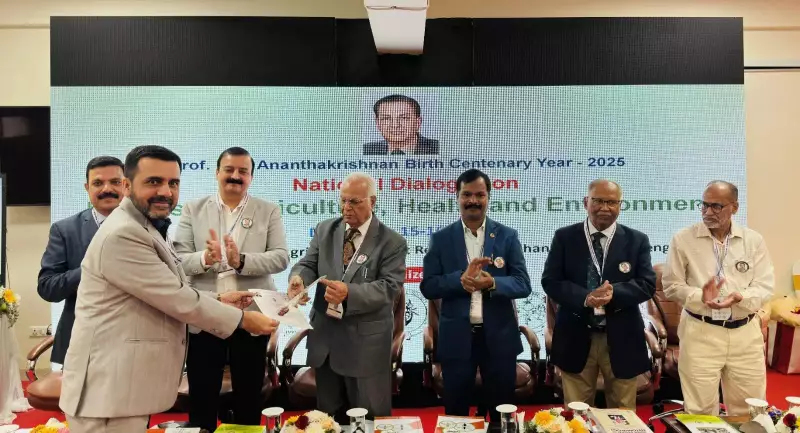
In a significant honour for India's scientific community, Dr Navneet Singh, a renowned Lepidoptera taxonomist at the Zoological Survey of India (ZSI) in Kolkata, has been conferred the distinguished Professor T.N. Ananthakrishnan Award for Senior Scientist (2024–25).
A Celebration of Entomological Excellence
The award was presented on Monday in Bengaluru during the National Dialogue on “Insects in Health, Agriculture and Environment.” Instituted by the Prof. T.N. Ananthakrishnan Foundation in partnership with the Entomological Society of India, it recognises scientists for their outstanding and sustained contributions to insect research. The award commemorates the legacy of the late Professor T.N. Ananthakrishnan (1925–2015), a pioneer of Indian entomology.
Dr Dhriti Banerjee, Director of the Zoological Survey of India, congratulated Dr Singh, stating the award rightly acknowledges his lifelong commitment to biodiversity science. She emphasised that “Dr Singh’s work provides a critical foundation for conservation planning” and highlights taxonomy's vital role in tackling modern environmental issues.

Pioneering Research on Moths and Butterflies
Since 2010, Dr Navneet Singh's work has dramatically advanced the understanding of India's insect biodiversity. As a leading expert in classical taxonomy and ecology of Lepidoptera—the order containing moths and butterflies—he has filled crucial knowledge gaps.
His remarkable achievements include:
- Description of a new superfamily and family of insects.
- Identification of 20 new genera and 191 new species.
- Publication of over 230 research papers and five monographs.
- Authorship of the landmark reference book, An Illustrated Guide to the Lepidoptera of India, documenting 101 families.
Groundbreaking Discoveries and Digital Legacy
In recent years, Dr Singh's research has shed new light on the ecological role of moths as pollinators, a field previously overlooked. His studies have identified:
- 91 species of settling moths and 16 species of hawk moths as significant pollinators.
- At least 37 moth species that are crucial for pollinating eleven economically important plant species.
These findings offer vital insights into “night-time pollination” and present new avenues for sustainable agriculture, especially amid global declines in daytime pollinators.
Beyond field research, Dr Singh has been instrumental in digitising India's faunal records. He led the creation of an online checklist of 13,124 Lepidoptera species on the ZSI website, a key open-access resource for global scientists. A comprehensive printed catalogue is also in the works.
The Zoological Survey of India, established in 1916, remains the nation's premier institution for zoological research and exploration. Dr Singh's award underscores its continued role in documenting and conserving India's immense biological wealth.