Anubhav Sinha's Cinematic Journey: Rediscovering India's Small-Town Theaters
For years, distribution teams would regularly inform filmmaker Anubhav Sinha – often with charts and data – that intelligent cinema does not work in smaller centers or single-screen theaters. This came as surprising news to Sinha, who as a youngster had watched films like Ardh Satya, Chakra, Dharavi, Khamosh, Jaane Bhi Do Yaaron, and Akrosh in packed theaters – many of them single screens located in smaller towns.
The Data Dilemma and a Personal Disconnect
Apparently, according to industry data, intelligence had since migrated exclusively to metropolitan areas. Sinha was shown extensive data, with the common refrain that data never lies – though it occasionally misses crucial reasons and context. This narrative left him questioning his own experiences and observations.
Earlier in 2025, while working on a script about youngsters in a small town, Sinha realized he had no idea what young people in small towns actually did anymore. He felt strangely disconnected from his roots, which created a significant challenge when writing authentically about them. These were not answers available in books, newspapers, or panel discussions – they needed to be experienced firsthand.

The Birth of Chal Cinema Chalein
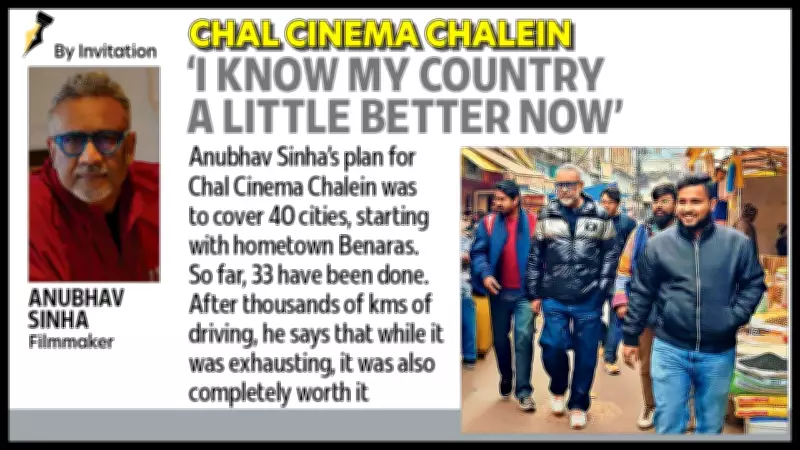
Meanwhile, another idea was quietly taking shape. Sinha developed a plan for Chal Cinema Chalein, aiming to cover 40 cities starting with his hometown of Benaras. So far, he has completed 33 cities, traveling thousands of kilometers by car. Despite the exhaustion of constant travel, rotating hotel rooms, and unfamiliar beds, he describes the experience as completely worth it.
The journey began with a firm decision: no fine dining, all meals would be street food, and he would meet anyone who wanted to meet him. What started as a cinematic exploration soon transformed into something much broader – encompassing people, society, changing culture, history, and yes, an alarming amount of street food.
Contradicting Popular Narratives
During his travels, Sinha encountered two dominant narratives that he sought to investigate:
- The declaration that cinema theaters were dead, supposedly killed by COVID-19
- The belief that smaller centers wouldn't watch intelligent cinema
Interestingly, films continued to break box-office records with impressive disregard for these obituaries. 2022 gave us The Kashmir Files and Bhool Bhulaiyaa 2, while 2023 followed with Pathaan, Jawan, Animal, and Gadar 2. The box office was witnessing numbers so large they required new adjectives, yet article after article mourned the death of theaters.
Discovering the Ground Reality
Sinha decided to investigate for himself, recognizing that multiplex chains represent only about half of India's theatrical business. The other half exists largely ignored, away from press releases and publicity materials. He wanted to meet cinema hall owners in smaller cities and ask them what was actually happening.
In every city, Sinha visited cinema halls – some crumbling, some renovated, some in ruins, and some flourishing. Almost unanimously, the owners dismissed both popular beliefs: that theaters were dying, and that smaller centers wouldn't watch intelligent cinema.
A Transformative Experience
The journey became increasingly personal and revealing. In Benaras, a group of young digital creators invited Sinha for a 6:30 AM photowalk followed by a breakfast crawl. They showed him parts of his own city he had never seen and eateries he had never entered. That morning, he realized something uncomfortable but important: he had been away too long from the realities of small-town India.
Over weeks of travel across 33 cities, Sinha met digital creators, film clubs, theater workers, literary organizations, vice-chancellors, and senior journalists. He visited schools, colleges, universities, newspaper offices, and radio stations. Young people ferried him around on motorbikes, navigating traffic with a confidence he admits he no longer possesses.

Industry Reflections and Future Implications
Sinha expresses wariness about public self-flagellation regarding Bollywood, noting that while the industry has flaws, so does most of humanity. He acknowledges there are technical explanations for why Mumbai's data might show poor collections for non-massy films in smaller centers, but these don't fit neatly into headlines.
When friends ask what he learned from this journey, Sinha admits he doesn't have a tidy answer and may never have one completely. When he asked filmmaker Sudhir Mishra what this journey might do to him, Mishra responded: You will never know. But it will show up in your future work. This felt both accurate and safely unquantifiable to Sinha.
The original plan of forty cities has quietly expanded to sixty – just in North India. Through days of driving three to four hundred kilometers, experiencing rotating hotel rooms, and developing a growing intimacy with unfamiliar beds, Sinha concludes: I know my country a little better now.