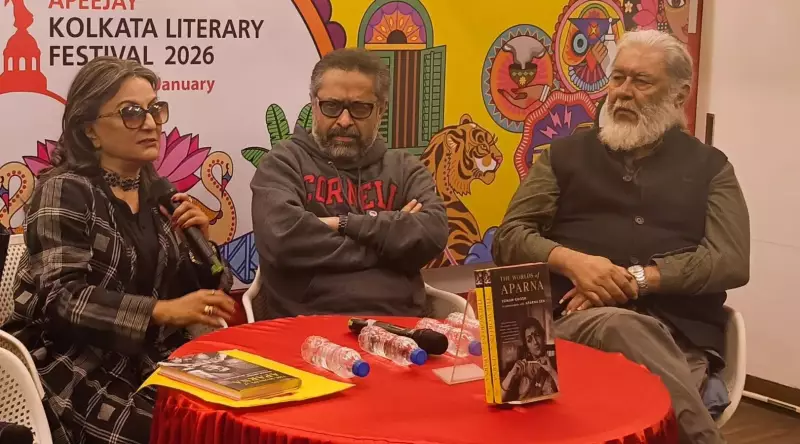
In a deeply reflective and candid session, iconic Indian filmmaker, actor, and writer Aparna Sen offered a rare glimpse into her creative mind and political consciousness. The engaging conversation took place on Friday as a highlight of the Kolkata Literary Festival 2026.
Aparna Sen Unplugged: The Artist's Philosophy
The session, aptly titled 'Aparna Sen Unplugged', featured the legend in conversation with filmmaker Suman Ghosh and author-poet Kalyan Ray. Esteemed journalist Raju Raman moderated the discussion, which spanned Sen's illustrious decades-long career across multiple creative fields.
With her characteristic clarity, Sen defined her relationship with cinema. She firmly stated that she views film as an expressive medium, not a platform for preaching. "I don't want to use cinema as a kind of pulpit for preaching. I'm not a preacher. I'm an artist," Sen asserted. She explained that her films are born from a place of personal disturbance and a compelling need to communicate what she finds profoundly meaningful at a specific point in time.

She elaborated that cinema does not have to tackle every subject under the sun. Instead, its true power lies in engaging deeply and authentically with the complexities of human experience.
Political Disturbance and Cinematic Response
A significant part of the dialogue navigated the political undercurrents present in much of Sen's work. She recalled the genesis of her film 'Ghare Baire Aj', revealing it was conceived in the wake of a sleepless night following the tragic murder of journalist Gauri Lankesh.
Drawing inspiration from Rabindranath Tagore's politically charged novel, Sen spoke of her growing unease with the shifting socio-political landscape. "The way my idea of India was changing right before my eyes" compelled her to craft a cinematic response. This reflection highlighted how external political realities inevitably seep into an artist's inner world and demand expression.
The Films That Defined Her Journey
When prompted by fellow filmmaker Suman Ghosh to name the films that gave her the greatest satisfaction, Sen returned to her roots. She spoke fondly of her directorial debut, the timeless classic '36 Chowringhee Lane'.
She attributed part of the film's authentic texture to her intimate, sensory knowledge of Kolkata. "I knew all the sounds, I knew what the light was like at certain times of day," she said. This insight underscored her belief that cinematic power often resides in subtle visual nuance rather than overt narrative exposition.
"It can be a hand lying in a shaft of light… and that hand can become very expressive," Sen noted, illustrating how small details can carry immense emotional weight.
Offering a unique perspective, Kalyan Ray shared his observations on the evolution of Sen's creative process over the years. He highlighted the constant tension every artist navigates: the battle between the 'inner eye'—the deeply private wellspring of creation—and an acute awareness of the outside world that shapes the final work.
The discussion also tackled the perennial question of an artist's responsibility. When asked if filmmakers must take political stands, Sen acknowledged that films like 'Arshinagar' and 'Ghare Baire Aj' were indeed driven by political disturbance. However, she clarified that her primary intention has always been to provoke thought and raise poignant questions, not to deliver simplistic conclusions or sermons.
The 'Aparna Sen Unplugged' session ultimately provided the audience with a layered, nuanced portrait of a cultural trailblazer. Despite her monumental stature in Indian cinema, Sen revealed that she approaches every new project with the fresh-eyed wonder and nervous excitement of a beginner, "always with the approach of a first-timer."