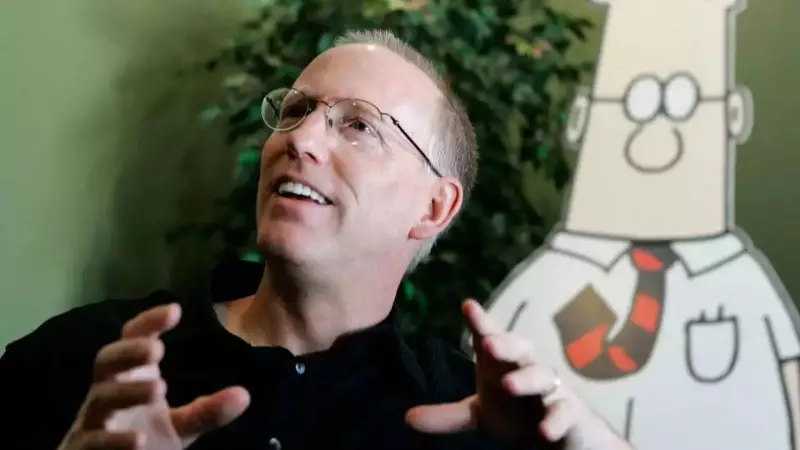
Scott Adams, the American cartoonist who created the famous Dilbert comic strip, has passed away at age 68. His family confirmed he died from aggressive prostate cancer. Adams gained worldwide recognition for his satirical take on corporate office life through Dilbert, which appeared in more than 2,000 newspapers at its peak.
From Corporate Satire to Controversy
Adams began his career working in banking and telecommunications management. He used his experiences to create Dilbert, a daily comic that humorously exposed the frustrations of office work. For many years, readers across the globe enjoyed his witty observations about corporate culture.
However, Adams later became known for controversial statements. In recent years, he transformed into a vocal supporter of the MAGA movement. His public comments took a troubling turn when he made racist remarks on his podcast in 2023. These statements led hundreds of newspapers to drop his comic strip.

The Creation of Asok
In 1996, Adams introduced an Indian character named Asok to the Dilbert universe. Asok came from the Indian Institute of Technology, though IIT was not widely known internationally at that time. Adams explained he wanted to reflect growing workplace diversity in America.
"I modeled a character after him for the Dilbert strip because I wanted to add greater variety," Adams said in a 2003 interview. "Bringing an Indian to the mix helped reflect the diversity of the American corporate world."
When asked why he chose an Indian character specifically, Adams gave a revealing answer. "Well, it was impossible to add an African-American," he stated. "When you are as white as I am, you have to be careful. To make a comic strip character funny, you have to make him flawed, and that is a sensitive issue."
Problematic Portrayals
Asok appeared occasionally in Dilbert strips, often as a subject of ridicule despite his intelligence. In one memorable episode, Asok claimed he could heat tea by holding it to his forehead and imagining fire. While presented as humor, these portrayals reflected Adams' own workplace frustrations.
Adams felt he had been passed over for promotions at Pacific Bell and Crocker National Bank because he was white. This resentment sometimes surfaced in his comic strips. In one strip, Asok says he got promoted to senior engineer because "I told my boss there wasn't much diversity in those positions" – implying the promotion wasn't based on merit.
Changing Times and Attitudes
Adams "killed" the Asok character in 2007, then brought him back in 2008 as part human, part Snickers bar. This happened around the time Barack Obama became U.S. President. By the time Donald Trump took office, Adams' resentment had fully transformed into support for MAGA politics and narratives of white victimhood.
In 2022, Adams introduced Dave, the Black Engineer, to mock office diversity initiatives and transgender issues. His commentary grew increasingly divisive even as he continued earning millions from his comic strip syndication.
Legacy and Impact
Despite recent controversies, Adams built a significant legacy through Dilbert. The comic strip resonated with office workers worldwide who recognized their own workplace struggles in his characters. At its height, Dilbert became a cultural phenomenon that defined how many people viewed corporate life.
Today, many major technology companies have Indian CEOs, including Microsoft, Google, FedEx, and IBM. Numerous leaders come from IIT backgrounds, achieving success through merit rather than affirmative action. This reality contrasts sharply with some of Adams' later narratives about workplace diversity.
Adams continued making arguments about white victimhood despite historical wisdom. Frederick Douglass, the social reformer and abolitionist, once noted that "the white man's happiness cannot be purchased by the black man's misery." This perspective seems lost in Adams' later years.
Scott Adams leaves behind a complicated legacy. He created one of the most successful comic strips in history while also generating significant controversy through his personal views and public statements. His work reflected both the humor and tensions of modern corporate life, even as his personal journey took troubling turns.