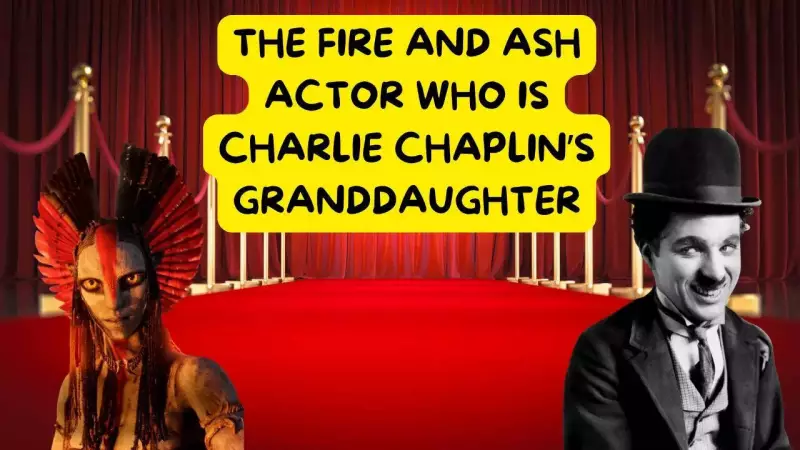
In the visually spectacular world of Pandora, a new kind of threat emerges in Avatar: Fire and Ash. Oona Chaplin enters the franchise not as a cackling, one-dimensional antagonist, but as Varang, the severe and disciplined leader of the Ash People. American critics have quickly highlighted how her performance stands out amidst the film's digital grandeur, marking her as a uniquely unsettling presence.
A Villain Defined by Coherence, Not Rage
Reviewers describe Chaplin's portrayal as chilling and unusually grounded. What makes Varang disturbing is not explosive anger, but her absolute certainty. She does not posture; she governs. Chaplin embodies this with a controlled physicality, measured speech, and an unblinking belief in her own moral logic. The effect is profound: Varang feels less like a mere plot obstacle and more like a fully realized, competing worldview.
In a series often critiqued for its straightforward ethics, Chaplin introduces vital friction. Varang is not evil because the script dictates it. She is dangerous because she is coherent and ideologically sound. Critics note her ability to hold the frame even when surrounded by massive spectacle, a testament to how director James Cameron's technological maximalism briefly steps aside to let an actor underplay—a choice that feels both unfashionable and powerful.

The violence she orchestrates feels procedural; her cruelty feels administrative. This unnerving approach is widely seen as a corrective to the franchise's tendency toward moral simplicity, adding a layer of frightening plausibility to the conflict.
The Ghost of Talisa Maegyr and the Legacy of Belief
For many viewers, Oona Chaplin remains inextricably linked to one of television's most traumatic moments: the Red Wedding in Game of Thrones. Her character, Talisa Maegyr, was stabbed to death in a scene that devastated audiences. The power of that moment lay not just in the bloodshed, but in what was extinguished with her.
As Talisa, Chaplin played a rare beacon of ethical coherence in Westeros—a pragmatic, compassionate figure sceptical of romantic heroics. Her performance made Talisa feel like an outsider, someone whose decency was doomed in a world ruled by strategy. Her death left a moral vacuum that fundamentally changed the story's tone.
This is the connective tissue between Talisa and Varang. Chaplin excels at embodying belief systems rather than just personalities. Whether portraying humane compassion or horrifying domination justified by survival, she builds characters from internally consistent moral frameworks. Her performances insist that ideas have tangible weight, and that weight has severe consequences.
The Chaplin-O'Neill Inheritance: A Method of Restraint
Only by examining her extraordinary lineage does her method become fully clear. Oona Chaplin is the granddaughter of Charlie Chaplin, cinema's original moral engineer who communicated dignity and injustice through precise physicality. She is the daughter of Geraldine Chaplin, known for performances of interior tension and emotional withholding in European cinema.
Furthermore, she is the great-granddaughter of playwright Eugene O'Neill, who dismantled American theatrical optimism with haunted, verbose characters. Chaplin sits at a rare intersection of silent-film physicality, modernist theatre, and contemporary realism.
Yet, she does not trade on this pedigree. There is no performative gravitas. Instead, what surfaces is a profound method: she trusts restraint, stillness, and the notion that characters need not explain themselves to justify their existence. This instinct feels almost anachronistic in an era of algorithm-driven performances.
In Avatar: Fire and Ash, this instinct pays off brilliantly. Varang lingers in the mind because she is not engineered for redemption arcs or meme culture. She is ideological, inconvenient, and heavy. Similarly, Talisa lingered because her removal left a scar. Across genres, Chaplin's performances leave a residue—a haunting quality that is her most precise inheritance.

Charlie Chaplin believed cinema should haunt. Eugene O'Neill believed drama should wound. Geraldine Chaplin believed in the virtue of ambiguity. Oona Chaplin's work in Avatar suggests she believes in all three. That is why her villain feels different: not louder or grander, but undeniably, unsettlingly heavier.