Prosenjit Chatterjee Walks Down Memory Lane at Historic NT1 Studios
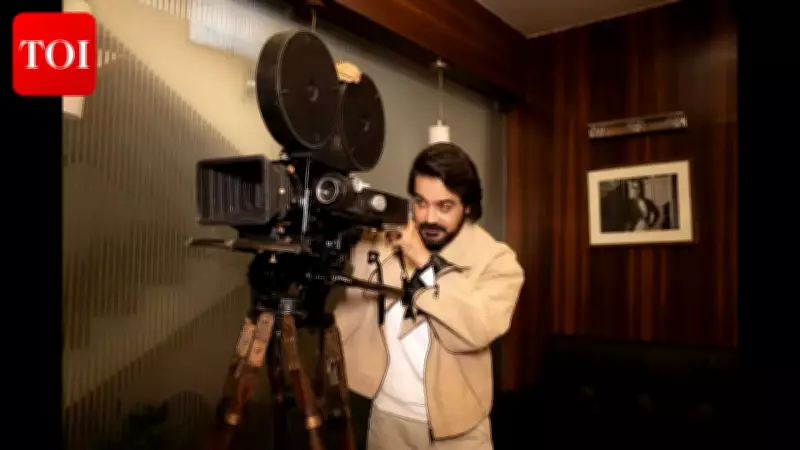
We meet Prosenjit Chatterjee, affectionately known as Bumbada, at the iconic NT1 studios one afternoon. The Padma Shri awardee emerges from his SUV dressed in crisp white and beige athleisure, moving with agile grace as he navigates from the bustling studio floors to the makeup rooms and then to the weathered spaces that once hosted legends of Bengali and Indian cinema.
A spontaneous gathering of television actors and studio workers forms around him, radiating genuine warmth and admiration as he engages in conversation, listening as intently as he speaks. He becomes our guide through these historic corridors – pointing out where his journey began as a young actor, sharing memories of communal meals, shared mirrors, and cigarettes with colleagues.
Where Magic Was Born: Reliving Cinematic History
He shows us the room where he completed his first dubbing session, where initial film cuts were previewed for exhibitors, and where entire fictional towns could materialize overnight for romantic sequences between heroes and heroines. In this expansive conversation with Calcutta Times commemorating its 25th anniversary, 'the industry' literally walked back through time, reflecting on an extraordinary acting journey, enduring motivations, and the creative partnership he misses most deeply.

'When I started my career, I was just fighting to establish myself and my cinema,' Prosenjit recalls. 'Like any beginner, I had to listen to the script, the director, the music. I struggled a lot initially. But after Amar Sangee (1987) – I became a romantic hero.'
Staying Relevant Across Changing Cinematic Landscapes
With more than four decades spanning multiple film industries and countless accolades, how does he maintain relevance amid constantly evolving filmmaking paradigms?
'I don't think that way,' he responds thoughtfully. 'I have always believed that whether you are a star, an actor, or a director, you create for a larger audience. And every few years, the audience changes. Their mindset changes. Their likings change. And I always wanted to stay connected with common people. If you keep yourself away, you won't know what the world wants. God was kind, as I was right most of the time.'
Pioneering Innovations in Bengali Cinema
During his commercial peak, Prosenjit embraced considerable experimentation. 'Yes, I introduced things people had not seen before,' he confirms. 'I used to work on my posters. There was no proper photoshoot poster culture in Bangla cinema before that. Then I started working on Cinemascope and took that risk for my film Purushottam (1992), shooting in Paris and Dubai.'
He continues: 'If Pratibad changed the way we did action in our cinema, with maturity, I understood I had to learn technology. I went to Prasad Lab in Chennai years back when CGI emerged. I stayed there for three weeks just to understand what they were doing. Like now, I'm trying to learn AI.'
The Philosophy of Continuous Evolution
Why is perpetual evolution crucial for him as an actor? 'I never calculate,' he states firmly. 'I never thought that if I did a commercial film and a film like Dosar, it would affect my career. I did Autograph and Moner Manush in the same year. In Autograph, I played a powerful, egoistic character. In Moner Manush, I played Lalon – a completely different soul, sacrificing everything. Two completely different characters. I took that risk. Both gave me box office success and a new audience.'
He shares wisdom passed from his mother: 'My Maa used to say, "Keep two kinds of people around you. Someone more educated than you, and someone much younger than you, who has no reason to flatter you." Young people speak from the heart. They will tell you, "This won't work." Which is why most people around me are younger than me. I need the connection.'

From Analogue Filmmaking to Artificial Intelligence
Beginning in a thoroughly analogue filmmaking era and now training himself to understand AI represents a monumental journey. 'Absolutely,' he agrees. 'Earlier, we had five actors standing together in one room and dubbing. Now you can dub anywhere with a small setup. Same with editing. I am a student of cinema. I am always curious. That's why I work with new generations. From Srijit Mukherji to today's Chandrasish Ray – I have always given myself to young directors. I have that hunger.'
He elaborates: 'A director who hasn't worked with me before will try to find another Prosenjit inside me. I learned this from Uttam Kumar, from Soumitra Chatterjee. They used to surrender to young directors. Reinvention is a small word. I want to do characters people haven't seen. It's difficult because I've done almost everything. Even my younger co-actors say that.'
Building for the Future: Incubation Labs and Micro Cinema
Regarding legacy building, Prosenjit reveals ambitious plans: 'I want to build something for creative people – students, talented writers – who don't get a space to show their work. Like an incubation lab. Not only in Bangla. I'm also working on micro cinema. If I can create 500-800 small theatres – affordable ones – for people without deep pockets, that would be giving back to the industry.'
He emphasizes: 'Everything finally comes back to Bangla cinema.'
What Sustains the Journey: Motivation and Missing Creative Partnership
What fuels his continued passion? 'It changes,' he admits. 'Sometimes I wake up with anger. Then I spend 7-8 hours in the gym and meditate. I've learned in the last 10 years that I cannot be angry. Sometimes I wake up thinking other regional industries are making more noise.'
His voice softens: 'And I miss my friend Rituparno Ghosh. Someone who could contribute with intellect and vision. Noise with substance. Nobody could dare to talk in front of him. That kind of jodi – my physical strength and his intellect – I miss that.'
He expresses a broader vision: 'I want more national work in Bangla. This is the same place – New Theatres – where Prithviraj Kapoor and Raj Kapoor started. We have the best technicians and talent. That's one reason I did Khakee. Not just Neeraj Pandey – but the presence of Bengal in that show. I feel proud when my actors and technicians are appreciated. People have deep respect for Bengali cinema, literature and culture.'
He concludes simply: 'At the end of the day, sometimes I just pray to my mother: Till my last breath, let me act and entertain people. Give me that strength. That's it. Nothing more.'
Embracing Constant Change in Cinema and Society
While connecting with technicians and support staff at NT1, Bumbada acknowledges their contribution: 'I am who I am because of your love.' He observes broader transformations: 'Change is constant. I see change everywhere now – in art, in business, in the way we live. Going out once meant Park Street. Today, every neighbourhood has its own buzz, pubs and restaurants. The suburbs have transformed. Someone is spending that money. Audiences are brand aware. They want the multiplex experience and are willing to spend Rs300 to Rs350 on a ticket. That shift is real.'
He shares final thoughts over tea with studio staff: 'We may not shout about it, but good things are happening around us. It is important these days to make some noise for the right reasons. But balanced noise.'
Prosenjit Chatterjee reflects on his approach: 'All of us have baggage. But with every project, I start from zero. I come as a malleable actor. I tell my directors, "Give me challenges. I will try."'
He emphasizes audience connection: 'I try to understand what audiences want today – their pulse, psychology, emotions. For that, you have to stay connected. Not with people who praise you, but also those who will tell you when you are wrong.'
Looking ahead, he notes: 'There are too many options competing for attention – cinema, OTT, short films, micro drama. India is the second largest producer of micro drama after China. That is where the future is headed.'