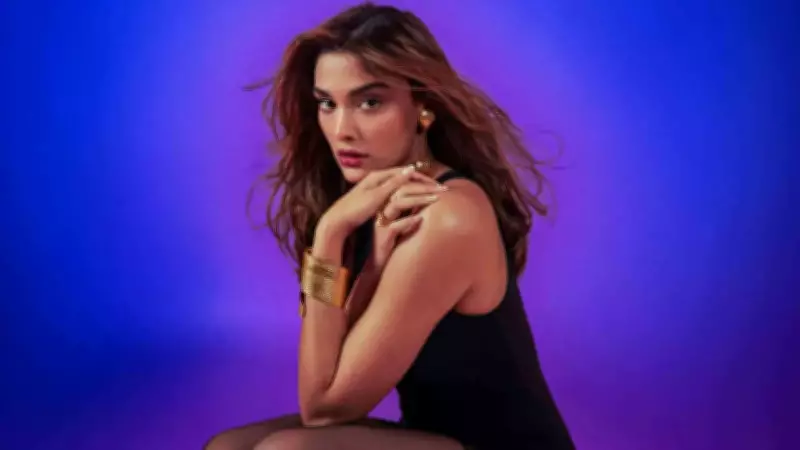
Saiee Manjrekar Steps into Period Drama with The India House, Shares Insights on Bilingual Filmmaking
For actress Saiee Manjrekar, the world of cinema has always been a familiar landscape. Her journey began early as a child artiste in the Marathi film Kaksparsh, before she made her prominent debut in the Bollywood blockbuster Dabangg 3. She subsequently expanded her repertoire into Telugu cinema with Ghani, starring opposite Varun Tej, and appeared in Major as the love interest of Adivi Sesh's character.
Embracing a New Challenge in Period Drama
Now, with her latest project The India House, Manjrekar is venturing into uncharted territory by taking on her first period drama role. "I love period dramas, and I really wanted to be part of one," she reveals enthusiastically. In the film, she portrays Sati, a young woman described as "very out there when it comes to opinions and her views." Speaking about her career trajectory, Manjrekar reflects on balancing projects across Hindi and Telugu cinema, the demands of maintaining authenticity, and her increasingly focused approach to her professional endeavors.
Authenticity and Research in Historical Portrayal
Set in the pre-Independence era, The India House presented Manjrekar with the unique challenge of trading spontaneity for research-driven restraint. "What was easy for me was that there's so much data available. You can do so much research about how people dressed, how people spoke," she explains, noting that the film's historical context helped her internalize the world more deeply. "To top that off, the setting, our backdrop of Hampi, really made it easier to get into that time period."

However, this required reconsidering her instinctive improvisation techniques. "We were shooting this film in Hindi and Telugu both. What gets tricky sometimes is not being able to improvise. With Telugu, I would probably just say my lines as they were given to me. But with Hindi, sometimes in the middle of a scene, I try to improvise or say one line on my own, and that doesn't work because I'm like, wait, people at that point probably didn't speak like this," she elaborates. "But once you get the hang of it, it's just about being in that character and believing in that time period and being authentic to it."
Shifting Perspective on Fame and Visibility
Reflecting on the pressures associated with being in the public eye, Manjrekar acknowledges that her perspective has evolved significantly over time. "I can't speak for everyone, but for me, there was pressure maybe two to three years ago, especially post-COVID. There was this void, and I felt like I needed to be seen more. But right now, I'm in a place where I'm keeping things more private between my life and my work. The opportunities I'm getting are exciting, and I want people to see me for that, not for anything else," she states candidly.
Acknowledging the inevitable scrutiny that accompanies her profession, she adds, "Once you're a public figure, you're out there for people to judge... your work, your looks, everything. That's part of it. It depends on how much you let it affect you." She emphasizes her current focus: "There was a time when I felt like I needed to be seen more, but that has changed. Today, I'm more focused on my work and keeping things private. I just hope people see me for the roles I take on and the effort I put into them."
Navigating Bilingual Cinema with Ease
Having worked on projects like Major in multiple languages, Manjrekar approaches bilingual shoots as an opportunity rather than a daunting challenge. "I don't think it's too challenging. In fact, it makes the process easier because I know exactly what I'm saying in both languages," she asserts. She highlights the advantage of carrying nuanced performances across different language takes: "For example, something that came naturally in my Hindi take, like a tone or emotion, we used that in the Telugu take as well."

"If you look at it as double the work, it'll bog you down. But if you look at it as something exciting and fun, then that's what it becomes," she advises. Emphasizing that her career choices are not constrained by language barriers, she notes, "Honestly, I believe it is important that the story is what matters. I've never been tied to a language barrier. I would love to work in every language there is."
Personal Passions and Connections
Outside of her film commitments, horse riding remains a cherished personal passion for Manjrekar, an interest that began in her early childhood. "I love it, I'm not trained in it, but I do love horse riding," she shares. Recalling the origins of this fascination, she adds, "I must've been about two or three years old when I picked up the fascination. We used to go to Matheran in Maharashtra on family trips, and one day they just put me on a horse. Since then, that passion has always been there." She describes the experience as "almost meditative," highlighting its significance in her life.
Manjrekar also expresses deep affection for Hyderabad, where she has filmed several projects. "The people of Hyderabad are so warm and welcoming. They make you feel at home, which is important because you miss home when you're away. I love that warmth and love. I have so many memories in this city. I call it a second home now," she reveals warmly.