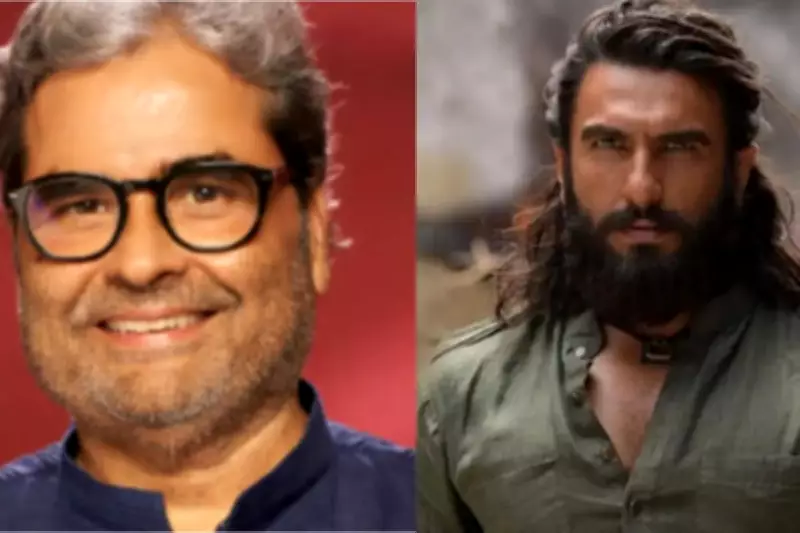
Vishal Bhardwaj's Controversial Social Media Endorsement Sparks Critical Examination of Artist-Audience Dynamics
This is not written as a critical takedown but as a reflection from someone who has spent years admiring the cinematic genius of Vishal Bhardwaj. The experience of walking out of the theater after watching Maqbool left an indelible mark of awe and respect for a filmmaker who redefined Shakespearean adaptations for Indian cinema.
The Legacy of Complex Storytelling
While Hollywood has produced numerous Shakespeare adaptations, Bhardwaj's trilogy—Maqbool (Macbeth), Omkara (Othello), and Haider (Hamlet)—taught audiences how to sit with discomfort and complexity. These films demonstrated how art should question, provoke, and navigate the full spectrum of human emotions, including those we often repress in our daily lives.
What Bhardwaj accomplished over decades was establishing a profound trust with his audience. His films and music consistently respected viewers' intelligence, trusting them to understand layered narratives and moral ambiguity. This mutual respect formed the foundation of his artistic relationship with cinema-goers.

The Moment of Dissonance
This makes the recent controversy particularly difficult to address. When Bhardwaj liked a social media post comparing audiences of Dhundhar 2: The Revenge to people performing Sieg Heil salutes, it felt less like artistic provocation and more like a betrayal of that carefully cultivated trust.
Dhundhar 2 has achieved remarkable commercial success, grossing over ₹1,661 crore worldwide and becoming the first pure Hindi film to cross the ₹1,000 crore net mark in India. This letter isn't about outrage but about dissonance—the same feeling experienced when watching Matru Ki Bijlee Ka Mandola, a film whose satire and dark humor were arguably ahead of its time.
The Danger of Historical Comparisons
The fundamental issue isn't whether people enjoyed Dhundhar 2—many did, including both installments. The problem lies in comparing any film audience to Nazis. The term "Nazi" carries the weight of unspeakable historical violence: antisemitism, the Holocaust, systematic genocide, gas chambers, ghettos, and industrialized murder that claimed six million lives.
To liken movie audiences—people who watch films for reasons ranging from admiration to curiosity to critique—to Nazis represents a complete collapse of the word's meaning. When meaning collapses, so does meaningful conversation.
Contradiction with Artistic Philosophy
What makes this particularly unsettling is how it contradicts Bhardwaj's own artistic philosophy. His films have consistently resisted flattening characters into simple categories. From the chaotic humanity of Kaminey to the quiet tenderness of Makdee and The Blue Umbrella, his work has celebrated complexity and contradiction.
Audiences are not monoliths. Some watch films because they love them, some because they disagree with them, some out of curiosity, and some simply seeking Friday evening entertainment. To collapse all these motivations into a single moral category is both inaccurate and unfair.
The Slippery Slope of Othering
More dangerously, this approach ventures into territory familiar to actual Nazis: the othering of people. Reducing any group to a single dehumanizing label—whether based on religion, caste, class, or ideology—forms the foundation of bigotry. When you call people "Nazis," you're not just criticizing them; you're placing them outside the circle of empathy, drawing lines between "us" and "them."
While this may not be Bhardwaj's intent, intent doesn't erase impact. The relationship between filmmaker and audience, built on mutual respect through films that demand patience and interpretation, risks fracturing when respect is replaced by contempt.
The Better Path Forward
What makes this moment particularly disappointing is that Bhardwaj's own cinema offers a superior approach. Haider didn't simplify Kashmir into good versus evil but let contradictions breathe. Omkara trusted audiences to recognize jealousy as a universal human failing. Maqbool presented ambition as both compelling and destructive.

These films trusted audiences to think—to engage with complexity rather than retreat to simplistic labels. The current controversy signals a shift from engagement to exasperation, from dialogue to dismissal, from the filmmaker who once invited us into complexity to one who, in this instance, appears to have stepped away from it.
In a world increasingly loud, reductive, and quick to judgment, Bhardwaj has spent a career building something finer. This moment, one hopes, remains the exception rather than a new pattern in how artists engage with their audiences in polarized times.