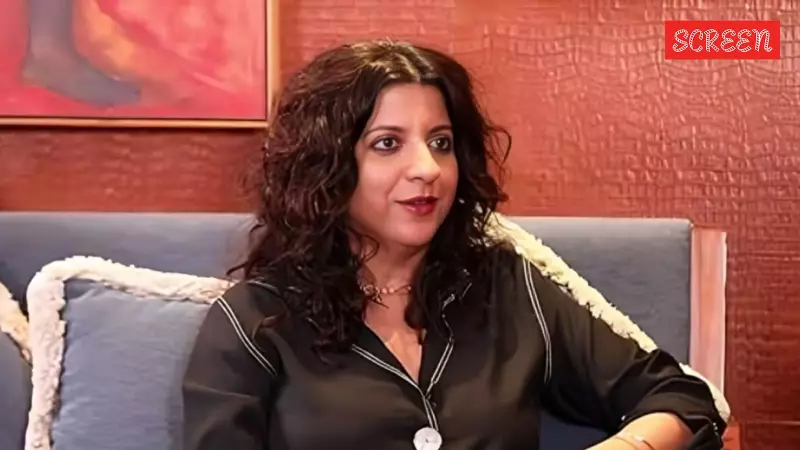
In a candid discussion that has reignited the perennial debate on privilege and access in Hindi cinema, acclaimed director Zoya Akhtar has offered a robust defence of Bollywood's openness. Speaking on The Swaddle's podcast, Akhtar challenged the pervasive insider-outsider narrative, stating unequivocally that the film industry is an accessible infrastructure for anyone with talent and drive.
The Core Argument: Industry as Infrastructure, Not an Exclusive Club
Zoya Akhtar directly addressed the criticism that Bollywood functions as a closed room favouring those with familial connections. "Firstly, we have to stop looking at the industry like it's a room, where you're either inside or outside," she asserted. "The industry is an infrastructure. Anybody can do what they want. Anybody can make a film. You can come in here, you can do what you want."
She pinpointed what she believes is a common misconception behind the complaints of exclusion. Akhtar suggested that much of the frustration is not about industry access per se, but about not landing roles in high-profile, big-banner projects. "See, the point is, a lot of people complain that they are not in the industry. But they're actually complaining because they're not in a Dharma film," she explained, referring to the influential production house run by Karan Johar. "You understand? It's not about not being in the industry. You want to act? You can act. And if you're acting, you're in the industry."

Statistics and Personal Experience: A Data-Driven Defence
Backing her stance with data, Akhtar urged critics to examine the broader trends of star creation in Bollywood. "You actually look at the statistics, every year more people who become stars are those who come from outside Mumbai, and from outside the industry, so to speak," she claimed. "They weren't born into the industry, right? They weren't born to someone who was already working here."
She also drew from her own journey and that of her close collaborator. Despite being the daughter of celebrated writers Javed Akhtar and Honey Irani, and sister to filmmaker Farhan Akhtar, Zoya highlighted that her directorial debut took nearly seven years to materialise. In contrast, she noted that her long-time creative and business partner, Reema Kagti—an "outsider from Assam"—managed to make her first film earlier.
Addressing 'The Archies' Backlash and Feeling Responsible
This is not the first time Zoya Akhtar has spoken about the charged nepotism discourse. Her recent project, the Netflix film 'The Archies', which launched the careers of star kids Agastya Nanda, Suhana Khan, and Khushi Kapoor, faced significant online trolling and criticism centred on privilege and access.
Reflecting on that period during an earlier appearance on Komal Nahta's podcast Game Changers, Akhtar expressed feeling guilty for the bullying faced by the young debutants. "They all are very talented and I would love to work with them again," she said. "What I felt terrible about was that they were newcomers... They just did what I asked them to do. I didn't like the fact that they were being almost bullied. It wasn't nice, it was all my responsibility, so I did feel guilty, but then they asked me not to."
The debate Akhtar engaged in has been a staple of Bollywood conversation for nearly a decade, intensifying after actor Kangana Ranaut famously labelled Karan Johar as "movie mafia" on his talk show. The rise of OTT platforms during the pandemic further amplified the discussion, providing a visible platform for talents like Jaideep Ahlawat and Pankaj Tripathi, often hailed as success stories for 'outsiders'.
Zoya Akhtar's comments present a counter-narrative to the dominant critique, framing Bollywood as a meritocratic field where persistence and skill, rather than just lineage, can lead to success. Her perspective adds a new layer to a complex conversation that continues to shape public perception of India's glamour industry.