The year 2025 will be remembered as a tale of two extremes for the Hindi film industry. While a select few cinematic spectacles shattered records and reaffirmed the power of the big screen, a surprising number of heavily promoted, big-ticket ventures stumbled, failing to recover their massive investments. This polarising trend has sparked intense debate about audience preferences, content viability, and the future of theatrical business models.
The Record-Breaking Titans
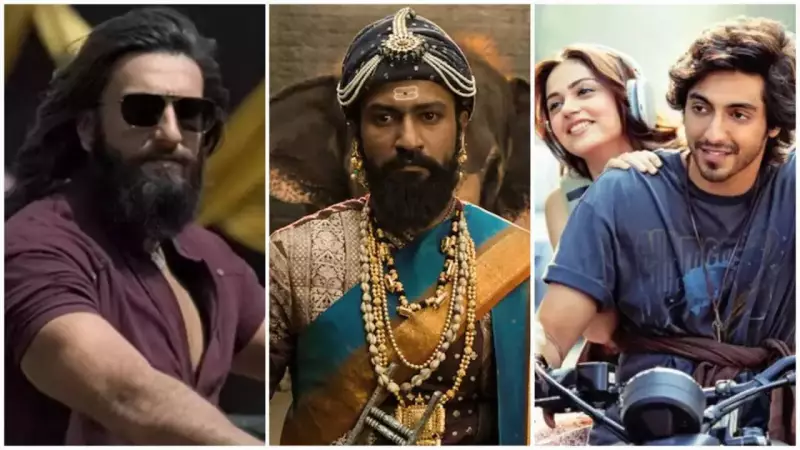
Leading the charge of monumental successes was Aditya Dhar's espionage thriller 'Dhurandhar', starring Ranveer Singh and Akshaye Khanna. Mounted on an epic scale, the film became a nationwide phenomenon, captivating audiences from metropolitan hubs to mass-market centres. Its historic box office run was powered significantly by repeat viewings. The film amassed a staggering Rs 690 crore in net collections in India and crossed Rs 1,025 crore in worldwide gross earnings, securing its status as an all-time blockbuster.
Close on its heels was the emotional juggernaut 'Chhaava', featuring Vicky Kaushal. This historical drama resonated deeply, particularly in Maharashtra and North India, blending strong storytelling with patriotic fervour. Sustained positive word-of-mouth gave it exceptional longevity in theatres. It collected Rs 601.54 crore net in India and Rs 807.91 crore globally, also earning the coveted 'all-time blockbuster' title.

Another highlight was the performance of the Hindi version of 'Kantara: A Legend – Chapter 1'. Rishab Shetty's mythological action prequel demonstrated remarkable pan-India appeal, proving cultural stories have universal pull. Its combined collection from all language versions reached Rs 622.04 crore net in India.
Surprise Successes & Steady Performers
2025 also witnessed heartening victories for content-driven cinema and fresh talent. The romantic drama 'Saiyaara', led by newcomers Ahaan Panday and Aneet Padda, proved that well-crafted, music-led love stories still hold immense box office charm, crossing Rs 329 crore net in India.
Aamir Khan's 'Sitaare Zameen Par' found a strong connection with family and urban audiences, showing excellent staying power despite not being a massy blockbuster. Similarly, franchise films like 'Housefull 5', 'Raid 2', and 'Jolly LLB 3' leveraged brand loyalty to secure profitable runs, even with mixed critical reception.
The High-Profile Disappointments
The flip side of 2025's story is littered with expensive underperformers. The most shocking was the fate of 'War 2'. Despite the colossal pairing of Hrithik Roshan and Jr NTR in a sleek spy universe, the film could only muster solid, not spectacular, numbers. With a net India collection of Rs 236.55 crore against sky-high expectations and a massive budget, it was declared a commercial flop.
Salman Khan's mass action vehicle 'Sikandar' also failed to ignite the box office, with weak content and apparent audience fatigue leading to poor collections of around Rs 108 crore net. Other notable disappointments included the patriotic drama 'Sky Force', the comedy sequel 'Kis Kisko Pyaar Karoon 2', and the adult comedy 'Mastiii 4', all of which struggled to find a sustained audience.
Several mid-sized films, including the romantic comedy 'Tu Meri Main Tera Main Teri Tu Mera', Farhan Akhtar's '120 Bahadur', and the relationship drama 'Gustaakh Ishq', were virtually wiped out, failing to cross even the Rs 25 crore mark net in India amidst fierce competition.
Key Takeaways from a Volatile Year
The 2025 box office report card offers clear lessons. Unbridled scale alone does not guarantee success; it must be married to compelling content and resonant emotion, as seen with 'Dhurandhar' and 'Chhaava'. The audience has shown a declining patience for formulaic franchise extensions and star vehicles lacking substance.

Conversely, films with a strong, authentic core—whether rooted in culture, emotion, or novel storytelling—found robust patronage even with new faces or moderate budgets. The industry's polarization underscores a maturing market where content is the ultimate king, and the stakes for misjudging audience appetite have never been higher.